The first reason is its size: it is a relatively large country, with a sizeable population, which means there will likely be a market for your product.
It also has a decent level of digital maturity, with some room for continued growth. Italy has a population of 58.7 million people. Of these people, around 87% are currently online.
The appeal of this market only grows stronger when you realize that, according to the International Monetary Fund, Italy is the ninth-largest economy in the world in terms of GDP, and the fourth largest within Europe, after Germany, the UK and France.
Another reason is its strategic geographical location. Located on the Mediterranean Sea, it is well-connected to Europe, North Africa and the Middle East, meaning it is well-placed to do business with brands with a physical presence in any of these locations.
There is a fairly equal gender split, with 88% of males being internet users, along with 86% of females.
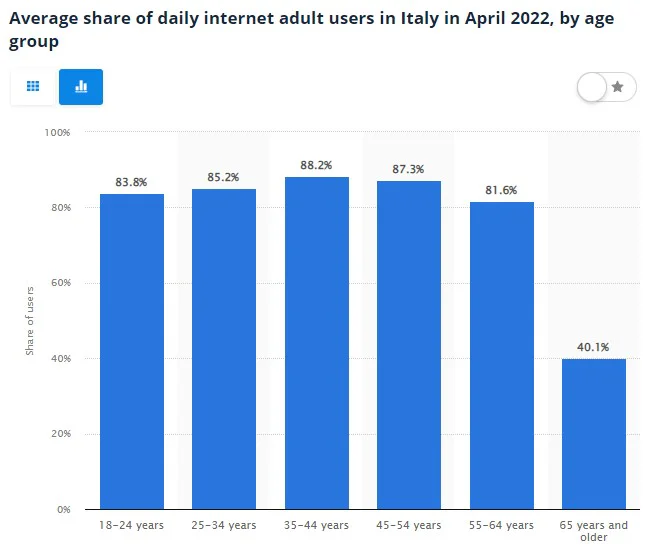
The graph below shows how many Italians use the internet on a daily basis, by age group. As you can see, there are high levels of daily internet use across the entire 18 to 64 age group, with this then dropping off significantly in the over-65s:
Historically, there has been a large digital divide between Italy’s north and south, with the richer north seeing significantly higher levels of internet penetration than the poorer south. However, this digital divide is narrowing, with the latest data showing that 81.5% of people in northern Italy use the internet, compared to 74% of people in southern Italy.
The typical Italian internet user spends 5 hours and 49 minutes online every day. Research by Meltwater and We Are Social found that the top three reasons Italian users gave for using the internet were: finding information, keeping up to date with news and events, and researching how to do things.
Online privacy is important to this group. According to recent research, 54% of Italian internet users decline cookies on websites, 34% worry about how companies might use their online data, 28% use ad blocking tools, and 20% use a VPN to access the internet.
54% of internet traffic in Italy comes from mobile phones, 43% comes from desktop computers, and 2% comes from tablets.
This means that it is extremely important to have a mobile-friendly website to meet the demands of internet users and provide them with a positive user experience when interacting with your brand and website. Mobile-friendliness is also an increasingly crucial ranking factor for search engines, so not optimizing your website for mobile will prove detrimental to your organic traffic.
Given the dominance of mobile, it should come as no surprise that apps are popular in Italy. During 2023, people in Italy collectively downloaded around 1.6 billion apps. These app users clocked up an annual spend of USD 1.2 billion on apps and in-app purchases, up 13% on the previous year. The popularity of apps presents a big opportunity for brands wanting to target the Italian market. If you create an app, make sure to localize the language, especially if you are B2C. Make sure your app functions correctly and is valuable for users, otherwise your brand might suffer not only from poor return-on-investment but also negative reviews.
Internet speeds are around the global average on mobile, but slower than the global average on broadband. Italy ranks 47th in the world for mobile internet speed, with a median speed of 53.63 MB per second. It ranks 68th for fixed broadband speed, with a median speed of 81.40 MB per second. The Italian government is aware of the slowness of the country’s broadband speeds, and plans to improve its broadband network to provide gigabit connectivity to all by 2026. It has also been granted €2 billion by the European Commission to support the roll out of 5G mobile networks in the country.
Given the variable internet speeds in the country, it is crucial to optimize your website for speed. If your website is too heavy and loads too slowly, this will result in higher bounce rates, meaning you could lose potential customers before they even have a chance to see what you have to offer. Google’s PageSpeed Insights tool is very useful for diagnosing any speed problems with your website and suggesting what you can do to make it faster.
Google is the most popular search engine in Italy, with a market share of 93%. Bing comes in second place with 4%, followed by Yahoo with 1%.
Google is therefore the search engine that you must focus your SEO and PPC efforts on. Make sure you are following best practices for search marketing on Google.
We cannot stress enough how vital it is to have a strong presence on Google. Recent research has found that search engines are the number one main channel for online brand research in Italy, as well as the number one source of brand discovery.
However, be aware that 28% of Italian internet users use an ad blocking tool. This means you do not want to rely completely on search advertising. Your organic SEO and content marketing efforts must also be given the attention they deserve in order to reach those internet users who have turned on an ad blocker.
Check that your geotargeting is correctly set up for your Italian website. This will vary depending on how you structure your domains, but you are likely to need hreflang tags correctly implemented to ensure that your Italy-targeted pages rank above your other country pages.
You should also check your website speed from within Italy, and if the loading speed is slow, consider hosting your website on a local server. You do not want to go through all the effort of creating, designing and localizing your website, just to have those efforts undone by poor loading speeds and high bounce rates as a result.
If you sell products on your website, make sure to display prices in the local currency, use local weights and measurements, and accept local online payment methods.
You should also make sure your customer support contact details are clearly visible and easy to find on your website, as your Italian customers will want to be able to get hold of you easily if they have any questions or problems.
Do not overcrowd your website with information; stick to the essentials.
And finally, make a point of creating and displaying local content, telling stories that are relatable and relevant to the local audience. This also includes the visuals and photos that accompany your written content.
Social media is very popular in Italy. Research by Meltwater and We Are Social found that among its sample of Italian internet users, 83% were social media users. The average internet user spends 1 hour and 48 minutes on social media every day and uses an average of 6 social platforms every month. The most common reasons for using social media are reading news stories, filling spare time, and keeping in touch with friends and family.
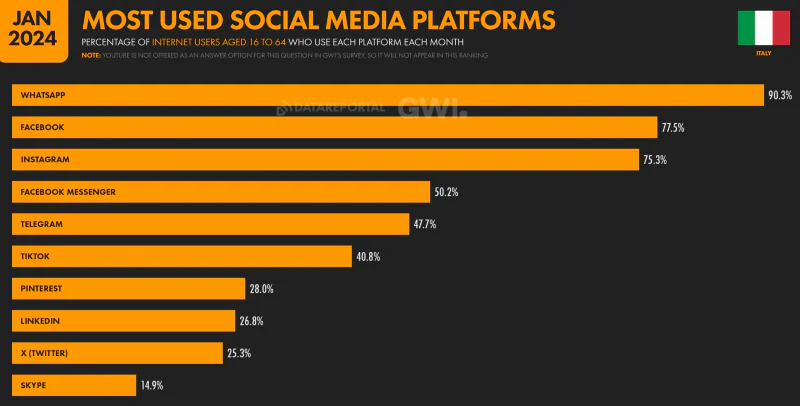
As you can see in the graph below, WhatsApp is the most popular social platform in Italy, followed by Facebook, Instagram and Facebook Messenger. All these platforms are used by more than half of all Italian internet users every month.
With 83% of Italian internet users being social media users, it is vitally important for brands to have a social media presence when targeting Italy. You should use social media to communicate and engage with potential customers, and it is also a useful way of understanding and getting to know your target audience. You should aim to create content that triggers emotions in users by offering real value or a real connection with your brand. Although you will obviously need to post localized content on your Italian social media accounts that caters to your audience in the country, your social media strategy will not differ significantly for Italy compared to how you do it for other countries. For example:
Of course, you do not need to be on every social media platform; you only need to be where your audience is. Research your industry and your audience before entering the market, see what platforms they prefer and prioritize them. Bear in mind that your audience will most likely be present on multiple platforms and interact with you across all of them, but they will not want to see the same things from you on all of them. Your content strategy should take into consideration both who your audience is and where they are interacting with you.
When entering any new market, it is very important to be aware of the local culture and to adapt your marketing collateral appropriately. One way you can examine the Italian culture is through the lens of Hofstede’s cultural dimensions.
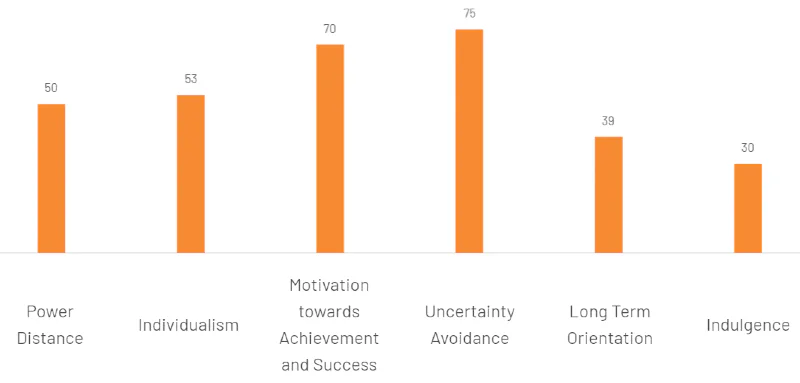
Italy has a score of 50 for power distance, placing it in the middle of the spectrum. This means that:
Italy has a score of 53 for individualism, placing it around the middle of the spectrum. This means that:
Italy has a fairly high score of 70 for motivation towards achievement and success. This means that:
Italy has a fairly high score of 75 for uncertainty avoidance. This means that:
Italy has a fairly low score of 39 for long-term orientation. This means that:
Italy has a fairly low score of 30 for indulgence. This means that:
From our experience helping global brands succeed in the Italian market, we can add that brand loyalty is fairly low, so consumers are open to switching between brands, as long as they are familiar with the brand. This again highlights the importance of building strong brand awareness in Italy.
And finally, be aware that superstition is very common in Italy, so certain imagery can denote good or bad luck. For example, a four-leaf clover denotes good luck, whereas black cats crossing in front of you, walking under a ladder on the street, and spilling salt on the table are all considered bad luck. There are a myriad of similar cultural images in Italy, so make sure that you research every image/symbol you want to use in your marketing campaign by working with a native Italian professional or a specialist agency such as TransPerfect Digital who can help you avoid cultural mishaps. This is especially important when targeting the southern area of Italy, the most superstitious part, where using the wrong image may cost you dearly.
When targeting Italy, make sure to create content in the local language, rather than trying to target them using English. The EF English Proficiency Index ranks Italy as having only moderate English proficiency, so any attempt to use English to reach Italians will be quite hit and miss. Furthermore, using English will give the impression that you do not really care about the market, since you cannot be bothered to communicate with them in their language, which would give a poor impression of your brand.
The language you should use when targeting Italy is Italian. Italian is a Romance language. It uses the Latin alphabet, is written from left to right and consists of 21 letters (the letters j, k, w, x and y do not appear in native Italian words, although they may appear in foreign loan words), with some letters being written with diacritical marks. It has two grammatical genders (masculine and feminine).
Translation, localization and copywriting should always be done by a professional native speaker. Only a native will have a proper grasp of the local linguistic and cultural nuances and be able to create content that will truly resonate with your local Italian audience.
Be aware that, online, Italians prefer a colloquial style and like to be addressed in the second person. Marketers should avoid formality and be on first-name terms with their customers. When targeting a young audience, it is acceptable to use slang terms, niche expressions and humor (if appropriate to your brand and messaging).
It is also very important to remember the regional nature of Italian culture, whereby regions play a central role in people’s identities and customs, and they vary a lot from one to the other. If you are only targeting a specific region, it may be worth using some regional dialectal terms, or introducing region-specific references. This can be very beneficial if you are targeting a specific region or area of Italy, especially in the southern part of the country.
Be aware that people in Italy will think poorly of you if you have mistakes in your written Italian content. If your content contains linguistic errors or if a translation does not make sense, your brand image could be damaged, with the poor-quality content gaining you a reputation as an unprofessional company.
You should also be aware that the Italian language is on average 10% to 25% longer than English. Therefore, be prepared to provide guidance on character limits and the space available for content on your webpage, and be conscious of how this can have an impact on things like your calls-to-action and product descriptions.
Speaking of calls-to-action, do not directly translate your calls-to-action from English into Italian, as a direct translation is unlikely to resonate and work well in Italy. Instead, do some research to find out which calls-to-action are commonly used online in Italy in your sector.
Another area of digital marketing that is impacted by the Italian language is dynamic keyword insertion. Italian does not always take dynamic keyword insertion kindly, due to grammatical gender issues. Dynamic keyword insertion puts you at risk of producing copy that is faulty and off-putting. If you must use dynamic keyword insertion, make sure to use several templates to adapt to as many cases as possible and limit errors.
It is also important to think about your keywords. Keywords should never be translated; instead, you should always conduct local keyword research. This is because a translation will probably not produce keywords that have the most impact in the target market. Only fresh keyword research conducted by a native speaker will reveal the best keywords to target.
While you should always create your content in Italian when it comes to your longer pieces of content and website, there is a slight caveat when it comes to short phrases or slogans in your adverts. Certain brands may find some benefit in having these in English, since foreign branding is a popular concept in Italy. A research paper published by Wiley found that “English is widely employed in advertising [in Italy] as an attention-getter, to evoke connotations of cosmopolitanism and modernity, and to add an international dimension to both global and local products”. When designing adverts and campaigns in Italy, it is useful to remember this, as the usage of short phrases or slogans in English could be beneficial if your brand is trying to cultivate an air of chic cosmopolitanism and modernity.
E-commerce is popular, although it still has plenty of growth ahead of it. 56% of Italians have made a purchase using a mobile phone or the internet in the past year. Online B2C sales are worth around €76 billion annually.
According to a study by Meltwater and We Are Social, the e-commerce categories which saw the highest levels of growth in 2023 compared to 2022 were: fashion with a year-on-year growth rate of 26%; luxury goods (spending up 21%); furniture (up 18%); household essentials (up 16%); electronics (up 11%); over-the-counter pharmaceuticals (up 9%); toys and hobby (up 8%); beauty and personal care (up 6%); and eyewear (up 3%). All other categories saw a decrease in spending. DIY and hardware saw the biggest reduction in spending, with spending falling 6% compared to the previous year, followed by tobacco products (spending down 5%), physical media (down 2%), beverages (down 1%) and food (down 1%).
The main drivers of online purchases are key indicators as to what Italian users value most when making their online purchasing decisions, giving you an opportunity to understand what is best to highlight in your marketing collateral and calls-to-action, so that you can convert leads into customers. Free delivery is the top driver of online purchasing behavior in Italy, with 62% saying this would encourage them to buy. This is followed by coupons and discounts with 49% and a simple online checkout process with 41%.
Looking at e-commerce payment methods, digital wallets are the most popular option, accounting for 35% of online purchases. Credit cards come in second place, accounting for 21% of online purchases, followed by prepaid cards (15%), debit cards (10%), account-to-account payments (9%) and buy now pay later (6%). It would therefore be wise to offer multiple payment options when targeting the Italian market, since various payment methods have significant popularity.
Another important thing to remember is to ensure you are selling in the correct currency: euros (€ or EUR). This may sound obvious, but you would be surprised how many businesses see poor results simply because they have neglected to localize the currency on their website.
When creating your price labels, be aware that Italy is one of the countries that uses the comma as a decimal separator, and not the point. Furthermore, the comma is not used as a thousand separator; instead, groups of digits are typically separated by a point. This is the opposite of how numbers are written in English-speaking countries. The bullet points below illustrate this by demonstrating how to write one hundred thousand euros in the English versus the Italian way. When targeting Italy, make sure that your prices follow the Italian standard, to ensure clarity.
Alternatively, you could sell your products on an e-commerce marketplace. The most popular e-commerce marketplace in Italy is Amazon. Subito comes in second place, followed by eBay, AliExpress and Temu. If you want to sell your items on an online marketplace, Amazon should therefore be your first choice when targeting Italy.
Once you have sold a product, you still need to get it to the customer. Be aware that the Italian postal service, Poste Italiane, has received numerous complaints from customers over the years because of unreliable service and lost, damaged or opened parcels. Unfortunately, this is a well-known issue, and it is especially bad with post arriving from abroad. For this reason, businesses are advised to use private couriers when it comes to shipping their goods to Italy, such as DHL, UPS, FedEx or similar.
Be aware that there are seasonal fluctuations in the Italian e-commerce calendar, when people are more likely to buy. The busiest times of the year in terms of online spending are seen in the run-up to the following dates: Christmas, Easter and Valentine’s Day. In recent years, Black Friday and Cyber Monday have also been adopted in Italy. Make sure you tap into this seasonality when selling your products and coming up with your marketing materials.
One thing you should be aware of is that many Italians prefer to buy “Made in Italy” products, as opposed to foreign brands, when given the choice. “Made in Italy” is a merchandise mark that denotes that a product is designed, created and packaged exclusively in Italy, and it is regulated by Italian law. It is seen as a synonym of luxury in Italy.
The sectors most affected by “Made in Italy” are food, wine, fashion, design, craftsmanship, manufacturing and engineering. If your products fall into any of the aforementioned categories, you should therefore be aware that competition in the country may be very fierce.
Do not let that put you off, though; so long as you have a unique selling point that sets you apart from the crowd, there could well be a place for you in the market.
The Italian market is a large and lucrative economy, with high levels of internet penetration, social media usage and growing levels of e-commerce uptake. It is a strong and established market that rightfully draws the attention of many global brands. We hope this guide has given you a good starting point from which to build your Italian success story. If you localize your strategy effectively, your digital marketing and business expansion efforts in the country have the potential to go far. Good luck!
Want to discuss how we can help your brand succeed in Italy? Let’s talk!
TransPerfect Digital
TransPerfect Digital combines best-in-class AI technology with deep human expertise in global marketing, content creation, and localization. As part of the TransPerfect family – operating in a language services market valued at $75.5 billion in 2024 and projected to reach $93.37 billion by 2030 (IMARC Group research) – we bring unmatched capabilities to help global brands connect with customers across languages, cultures, and markets. Our team of 200+ digital marketing specialists works alongside data scientists and AI engineers to deliver solutions that blend technological innovation with strategic insight. We serve more than 1,000 global brands across 170+ languages and 200+ markets.