The first reason is its size: it is a relatively large country, with a sizeable population, which means there will likely be a market for your product.
It also has a decent level of digital maturity, with some room for continued growth. Poland has a population of around 40 million people. Of these people, around 87% are currently online.
Another reason is its strategic geographical location. With its close proximity to the major economy of Germany, it is well-placed to do business with brands with a physical presence in this European powerhouse.
There is a slight gender imbalance, with slightly more women using the internet than men, according to the latest data from the Polish government.
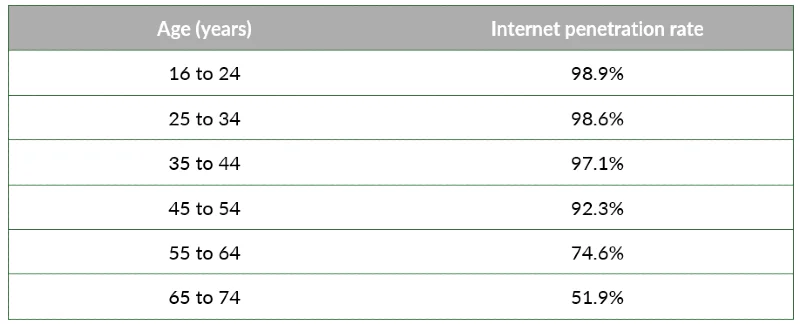
The table below shows the age distribution of “regular internet users” in Poland. As you can see, there are high levels of internet usage across the entire 16 to 54 age group, with this then dropping off sharply over the age of 55:
There is no major digital divide between urban and rural areas of Poland, with 95% of households in large cities enjoying access to the internet at home, compared to 93% in rural areas.
The typical Polish internet user spends 6 hours and 17 minutes online every day. Research by Meltwater and We Are Social found that the top three reasons Polish users gave for using the internet were: finding information, keeping up to date with news and events, and researching products and brands.
Online privacy is important to this group. According to recent research, 42% of Polish internet users worry about how companies might use their online data, 36% decline cookies on websites, 35% use ad blocking tools, and 22% use a VPN to access the internet.
70% of internet traffic in Poland comes from mobile phones, 29% comes from desktop computers, and 0.5% comes from tablets.
This means that it is extremely important to have a mobile-friendly website to meet the demands of internet users and provide them with a positive user experience when interacting with your brand and website. Mobile-friendliness is also an increasingly crucial ranking factor for search engines, so not optimizing your website for mobile will prove detrimental to your organic traffic.
Given the dominance of mobile, it should come as no surprise that apps are popular in Poland. During 2023, people in Poland collectively downloaded 1 billion apps. These app users clocked up an annual spend of USD 665 million on apps and in-app purchases, up 35% on the previous year. The popularity of apps presents a big opportunity for brands wanting to target the Polish market. If you create an app, make sure to localize the language, especially if you are B2C. Make sure your app functions correctly and is valuable for users, otherwise your brand might suffer not only from poor return-on-investment but also negative reviews.
Internet speeds are faster than the global average on broadband, and around the global average on mobile. Poland ranks 28th in the world for fixed broadband speed, with a median speed of 154.66 MB per second. It ranks 42nd for mobile internet speed, with a median speed of 56.97 MB per second.
Google is the most popular search engine in Poland, with a market share of 96%. Bing comes in second place with 3%, followed by DuckDuckGo with 0.5%.
Google is therefore the search engine that you must focus your SEO and PPC efforts on. Make sure you are following best practices for search marketing on Google.
We cannot stress enough how vital it is to have a strong presence on Google. Recent research has found that search engines are the number one main channel for online brand research in Poland, as well as the number one source of brand discovery.
However, be aware that 35% of Polish internet users use an ad blocking tool. This means you do not want to rely completely on search advertising. Your organic SEO and content marketing efforts must also be given the attention they deserve in order to reach those internet users who have turned on an ad blocker.
Check that your geotargeting is correctly set up for your Polish website. This will vary depending on how you structure your domains, but you are likely to need hreflang tags correctly implemented to ensure that your Poland-targeted pages rank above your other country pages.
You should also check your website speed from within Poland, and if the loading speed is slow, consider hosting your website on a local server. You do not want to go through all the effort of creating, designing and localizing your website, just to have those efforts undone by poor loading speeds and high bounce rates as a result.
If you sell products on your website, make sure to display prices in the local currency, use local weights and measurements, and accept local online payment methods.
And finally, make a point of creating and displaying local content, telling stories that are relatable and relevant to the local audience. This also includes the visuals and photos that accompany your written content.
Social media is popular in Poland. Research by Meltwater and We Are Social found that among its sample of Polish internet users, 78% were social media users. The average internet user spends 1 hour and 54 minutes on social media every day and uses an average of 6 social platforms every month. The most common reasons for using social media are keeping in touch with friends and family, reading news stories, and filling spare time.
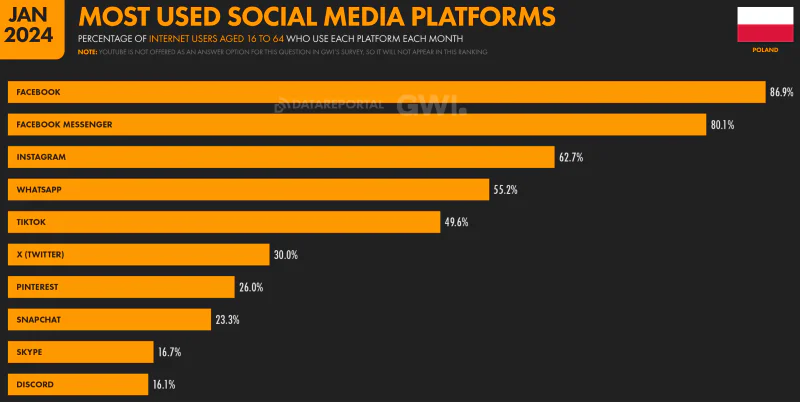
As you can see in the graph below, Facebook is the most popular social platform in Poland, followed by Facebook Messenger, Instagram and WhatsApp. All these platforms are used by more than half of all Polish internet users every month.
With 78% of Polish internet users being social media users, it is vitally important for brands to have a social media presence when targeting Poland. You should use social media to communicate and engage with potential customers, and it is also a useful way of understanding and getting to know your target audience. You should aim to create content that triggers emotions in users by offering real value or a real connection with your brand. Although you will obviously need to post localized content on your Polish social media accounts that caters to your audience in the country, your social media strategy will not differ significantly for Poland compared to how you do it for other countries. For example:
Of course, you do not need to be on every social media platform; you only need to be where your audience is. Research your industry and your audience before entering the market, see what platforms they prefer and prioritize them. Bear in mind that your audience will most likely be present on multiple platforms and interact with you across all of them, but they will not want to see the same things from you on all of them. Your content strategy should take into consideration both who your audience is and where they are interacting with you.
When entering any new market, it is very important to be aware of the local culture and to adapt your marketing collateral appropriately. One way you can examine the Polish culture is through the lens of Hofstede’s cultural dimensions.
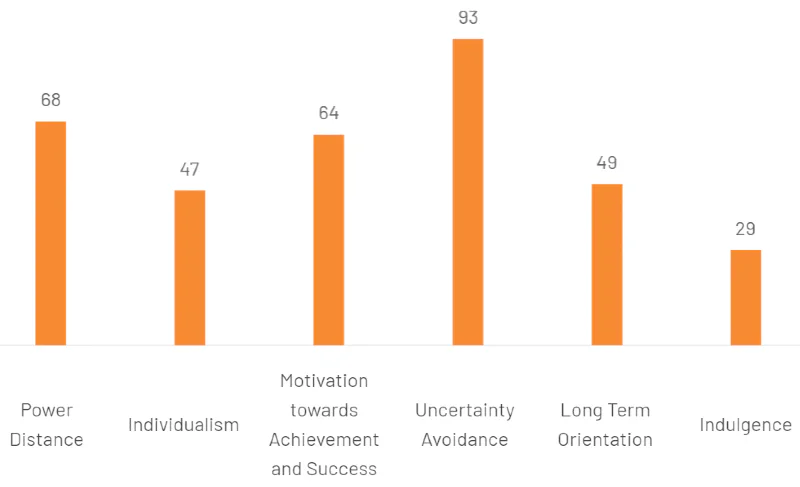
Poland has a fairly high score of 68 for power distance. This means that:
Poland has a score of 47 for individualism, placing it around the middle of the spectrum. This means that:
Poland has a fairly high score of 64 for motivation towards achievement and success. This means that:
Poland has a very high score of 93 for uncertainty avoidance. This means that:
Poland has a score of 49 for long-term orientation, placing it around the middle of the spectrum. This means that:
Poland has a fairly low score of 29 for indulgence. This means that:
Polish culture is strongly impacted by Catholicism, with around 79% of Poles having been baptized in the Catholic Church. Bear in mind that using Christian symbols in advertising is not welcomed in Polish society, and brands should avoid using religious connotations in their marketing materials, so as not to inadvertently cause offence.
On a different note, Poland’s history is very rich and for this reason the country has a strong cultural identity. Therefore, Polish brands may see good results if they create campaigns around important historical dates, such as Independence Day on 11 November, or Constitution Day on 3 May. On those dates, making use of images in the Polish national colors (white and red) could produce great results. While it would be inappropriate for foreign brands to build big marketing campaigns around these dates, they could nevertheless wish people “Happy Independence Day” on their social media accounts, as this could give a positive impression of the brand (so long as the brand is not from a country which has been a historical oppressor of Poland, such as Germany or Russia; it would be best for brands from these countries to stay quiet on these dates).
While the EF English Proficiency Index ranks Poland as having high English proficiency, it is still preferable to create content in the local language, rather than English, if possible – particularly if you are a B2C brand. Using English could give the impression that you do not really care about the market, since you cannot be bothered to communicate with them in their language, which could give a poor impression of your brand.
The language you should use when targeting Poland is Polish. Polish is a West Slavic language. It is written from left to right and consists of 32 letters (all letters of the English alphabet minus q, v and x, plus the Polish letters of ą, ć, ę, ł, ń, ó, ś, ź and ż). It has a complex grammar, with three grammatical genders (masculine, feminine and neuter) and seven cases, which means that every verb influences the form of the noun, adjective, adverb and other parts of the phrase.
Translation and copywriting should always be done by a professional native speaker. Only a native will have a proper grasp of the local linguistic and cultural nuances and be able to create content that will truly resonate with your local Polish audience.
Be aware that people in Poland will think poorly of you if you have mistakes in your written Polish content. If your content contains linguistic errors or if a translation does not make sense, your brand image could be damaged, with the poor-quality content gaining you a reputation as an unprofessional company.
You should also be aware that the Polish language can be as much as 20% to 30% longer than English. Therefore, be prepared to provide guidance on character limits and the space available for content on your webpage, and be conscious of how this can have an impact on things like your calls-to-action and product descriptions.
Speaking of calls-to-action, do not directly translate your calls-to-action from English into Polish, as a direct translation is unlikely to resonate and work well in Poland. Instead, do some research to find out which calls-to-action are commonly used online in Poland in your sector.
Another area of digital marketing that is impacted by the Polish language is dynamic keyword insertion. Polish does not always take dynamic keyword insertion kindly, due to grammatical gender and case issues. Dynamic keyword insertion puts you at risk of producing copy that is faulty and off-putting. If you must use dynamic keyword insertion, make sure to use several templates to adapt to as many cases as possible and limit errors.
It is also important to think about your keywords. Keywords should never be translated; instead, you should always conduct local keyword research. This is because a translation will probably not produce keywords that have the most impact in the target market. Only fresh keyword research conducted by a native speaker will reveal the best keywords to target.
When it comes to targeting keywords in your PPC campaigns, you might have a bit of doubt when it comes to diacritics, of which Polish has a few (ą, ć, ę, ł, ń, ó, ś, ź and ż). Of course, when it comes to your content, you should always use them and make sure they are used correctly. But when deciding which keywords to target in your paid advertising campaigns, you may want to target keywords in their diacritic and non-diacritic forms. Many times, Polish-speaking users will make their search queries without any diacritics just to save time, so if you do not target these keywords, you might be losing some valuable search volume.
E-commerce is popular in Poland, although it still has growth ahead of it. 68% of the total Polish population have made a purchase using a mobile phone or the internet in the past year. Online sales are worth the equivalent of USD 22 billion annually.
According to a study by Meltwater and We Are Social, the e-commerce categories which saw the highest levels of growth in 2023 compared to 2022 were: household essentials with a year-on-year growth rate of 16%; over-the-counter pharmaceuticals (spending up 9%); furniture (up 7%); fashion (up 3%); toys and hobby (up 3%); electronics (up 2%); and beauty and personal care (up 1%). All other categories saw a decrease in spending. Tobacco products saw the biggest reduction in spending, with spending falling 17% compared to the previous year, followed by physical media (spending down 7%), DIY and hardware (down 7%), eyewear (down 6%) and food (down 4%).
The main drivers of online purchases are key indicators as to what Polish users value most when making their online purchasing decisions, giving you an opportunity to understand what is best to highlight in your marketing collateral and calls-to-action, so that you can convert leads into customers. Free delivery is the top driver of online purchasing behavior in Poland, with 59% saying this would encourage them to buy. This is followed by coupons and discounts with 48% and a simple online checkout process with 46%.
Looking at e-commerce payment methods, account-to-account payments are the most popular option, accounting for 68% of online purchases. Digital wallets come in second place, accounting for 15% of online purchases. This is followed by debit cards with 7% and credit cards with 6%. It is therefore essential to offer account-to-account payments as a payment option when targeting the Polish market. The most popular account-to-account payment method is BLIK.
Another important thing to remember is to ensure you are selling in the correct currency: Polish złoty (zł or PLN). This may sound obvious, but you would be surprised how many businesses see poor results simply because they have neglected to localize the currency on their website.
When creating your price labels, be aware that Poland is one of the countries that uses the comma as a decimal separator, and not the point. Furthermore, the comma is not used as a thousand separator; instead, groups of digits are typically separated by a point. This is the opposite of how numbers are written in English-speaking countries. The bullet points below illustrate this by demonstrating how to write one hundred thousand złoty in the English versus the Polish way. When targeting Poland, make sure that your prices follow the Polish standard, to ensure clarity.
Alternatively, you could sell your products on an e-commerce marketplace. The most popular e-commerce marketplace in Poland is Allegro, followed by OLX, OTOMOTO, Ceneo and Temu. If you want to sell your items on an online marketplace, Allegro should therefore be your first choice when targeting Poland.
Once you have sold a product, you still need to get it to the customer. The most popular e-commerce delivery methods in Poland are collection from a parcel machine and courier delivery to the home or workplace, so it would be wise to offer these delivery options (if applicable).
Be aware that there are seasonal fluctuations in the Polish e-commerce calendar, when people are more likely to buy. The busiest time of the year in terms of online spending is seen in November and December, in the run-up to Christmas. Make sure you tap into this seasonality when selling your products and coming up with your marketing materials.
The Polish market is one that is both sizeable and has a decent level of digital maturity. It is a vibrant and promising market that is drawing the attention of an increasing number of global brands. We hope this guide has given you a good starting point from which to build your Polish success story. If you localize your strategy effectively, your digital marketing and business expansion efforts in the country have the potential to go far. Good luck!
Want to discuss how we can help your brand succeed in Poland? Let’s talk!
TransPerfect Digital
TransPerfect Digital combines best-in-class AI technology with deep human expertise in global marketing, content creation, and localization. As part of the TransPerfect family – operating in a language services market valued at $75.5 billion in 2024 and projected to reach $93.37 billion by 2030 (IMARC Group research) – we bring unmatched capabilities to help global brands connect with customers across languages, cultures, and markets. Our team of 200+ digital marketing specialists works alongside data scientists and AI engineers to deliver solutions that blend technological innovation with strategic insight. We serve more than 1,000 global brands across 170+ languages and 200+ markets.