The first reason is its digital maturity. The Netherlands has a population of 17.7 million people. Of these people, around 93% are currently online.
It is also a wealthy nation, with the Dutch typically enjoying high disposable incomes and being open to buying from foreign brands. According to the International Monetary Fund, the Netherlands has the seventh-largest economy in Europe in terms of GDP, which is impressive when you consider its relatively small population.
Another reason is its strategic geographical location. With its close proximity to the major economies of Germany and the UK, it is well-placed to do business with brands with a physical presence in either of these European powerhouses.
There is an equal gender split, with 50% of internet users being male and 50% being female.
The table below shows the percentage of people with internet access at home in the Netherlands, by age. As you can see, there are very high levels of internet access across the entire 12 to 75 age group, with this then dropping off over the age of 75:
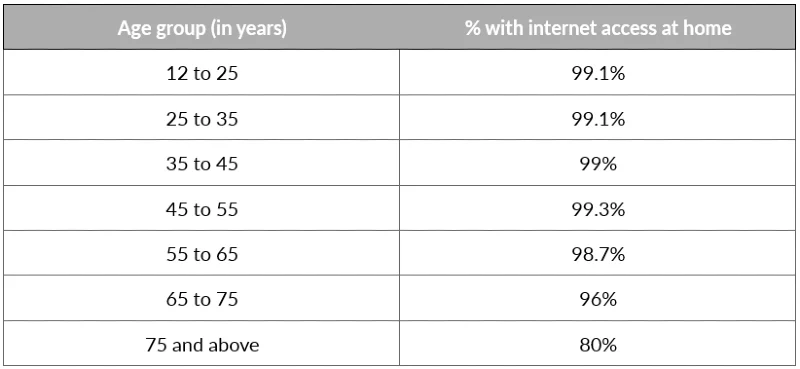
There is no major digital divide between urban and rural areas of the Netherlands, with 99% of urban households having internet access, along with 98% of rural households.
The typical Dutch internet user spends 5 hours and 30 minutes online every day. Research by Meltwater and We Are Social found that the top three reasons Dutch users gave for using the internet were: finding information, researching how to do things, and keeping up to date with news and events.
Online privacy is important to this group. According to recent research, 50% of Dutch internet users decline cookies on websites, 35% worry about how companies might use their online data, 31% use ad blocking tools, and 23% use a VPN to access the internet.
52% of internet traffic in the Netherlands comes from mobile phones, 46% comes from desktop computers, and 2% comes from tablets.
This means that it is extremely important to have a mobile-friendly website to meet the demands of internet users and provide them with a positive user experience when interacting with your brand and website. Mobile-friendliness is also an increasingly crucial ranking factor for search engines, so not optimizing your website for mobile will prove detrimental to your organic traffic.
Given the dominance of mobile, it should come as no surprise that apps are popular in the Netherlands. During 2023, people in the Netherlands collectively downloaded around 591 million apps. These app users clocked up an annual spend of USD 937 million on apps and in-app purchases, up 23% on the previous year. The popularity of apps presents a big opportunity for brands wanting to target the Dutch market. If you create an app, make sure to localize the language, especially if you are B2C. Make sure your app functions correctly and is valuable for users, otherwise your brand might suffer not only from poor return-on-investment but also negative reviews.
Internet speeds are faster than the global average. The Netherlands ranks 9th in the world for mobile internet speed, with a median speed of 120.96 MB per second. It ranks 18th for fixed broadband speed, with a median speed of 190.13 MB per second.
Google is the most popular search engine in the Netherlands, with a market share of 91%. Bing comes in second place with 5%, followed by DuckDuckGo with 1%.
Google is therefore the search engine that you must focus your SEO and PPC efforts on. Make sure you are following best practices for search marketing on Google.
We cannot stress enough how vital it is to have a strong presence on Google. Recent research has found that search engines are the number one main channel for online brand research in the Netherlands, as well as the number one source of brand discovery.
However, be aware that 31% of Dutch internet users use an ad blocking tool. This means you do not want to rely completely on search advertising. Your organic SEO and content marketing efforts must also be given the attention they deserve in order to reach those internet users who have turned on an ad blocker.
Check that your geotargeting is correctly set up for your Dutch website. This will vary depending on how you structure your domains, but you are likely to need hreflang tags correctly implemented to ensure that your Netherlands-targeted pages rank above your other country pages.
You should also check your website speed from within the Netherlands, and if the loading speed is slow, consider hosting your website on a local server. You do not want to go through all the effort of creating, designing and localizing your website, just to have those efforts undone by poor loading speeds and high bounce rates as a result.
If you sell products on your website, make sure to display prices in the local currency, use local weights and measurements, and accept local online payment methods.
And finally, make a point of creating and displaying local content, telling stories that are relatable and relevant to the local audience. This also includes the visuals and photos that accompany your written content.
Social media is very popular in the Netherlands. Research by Meltwater and We Are Social found that among its sample of Dutch internet users, 86% were social media users. The average internet user spends 1 hour and 30 minutes on social media every day and uses an average of 6 social platforms every month. The most common reasons for using social media are keeping in touch with friends and family, filling spare time and reading news stories.
As you can see in the graph below, WhatsApp is the most popular social platform in the Netherlands, followed by Facebook and Instagram. All these platforms are used by more than half of all Dutch internet users every month.
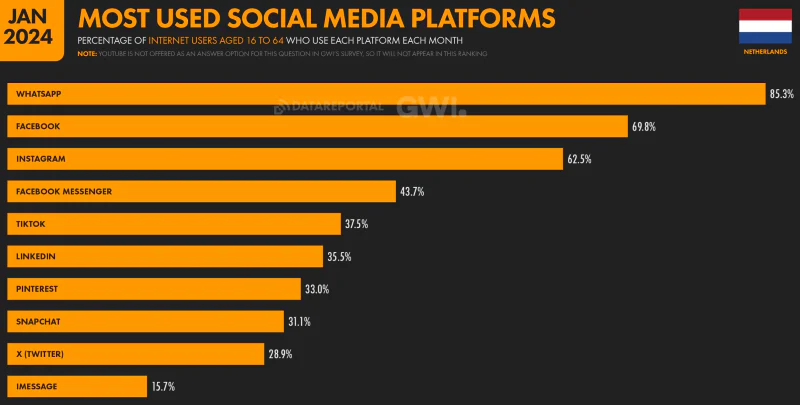
With 86% of Dutch internet users being social media users, it is vitally important for brands to have a social media presence when targeting the Netherlands. You should use social media to communicate and engage with potential customers, and it is also a useful way of understanding and getting to know your target audience. You should aim to create content that triggers emotions in users by offering real value or a real connection with your brand. Although you will obviously need to post localized content on your Dutch social media accounts that caters to your audience in the country, your social media strategy will not differ significantly for the Netherlands compared to how you do it for other countries. For example:
Of course, you do not need to be on every social media platform; you only need to be where your audience is. Research your industry and your audience before entering the market, see what platforms they prefer and prioritize them. Bear in mind that your audience will most likely be present on multiple platforms and interact with you across all of them, but they will not want to see the same things from you on all of them. Your content strategy should take into consideration both who your audience is and where they are interacting with you.
When entering any new market, it is very important to be aware of the local culture and to adapt your marketing collateral appropriately. One way you can examine the Dutch culture is through the lens of Hofstede’s cultural dimensions.
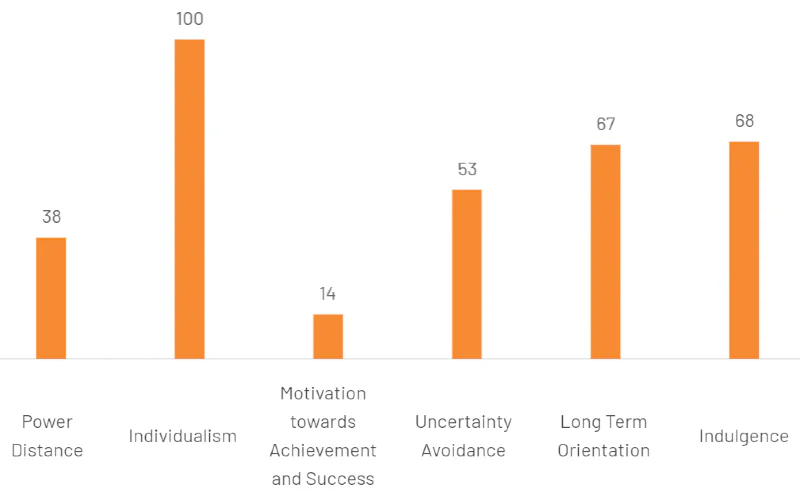
The Netherlands has a fairly low score of 38 for power distance. This means that:
The Netherlands has a very high score of 100 for individualism. This means that:
The Netherlands has a very low score of 14 for motivation towards achievement and success. This means that:
The Netherlands has a score of 53 for uncertainty avoidance, placing it around the middle of the spectrum. This means that:
The Netherlands has a fairly high score of 67 for long-term orientation. This means that:
The Netherlands has a fairly high score of 68 for indulgence. This means that:
Furthermore, the Netherlands is celebrated for being one of the most liberal and socially progressive countries in the world. It is also known for its highly open economy, leaning strongly towards international trade.
While the EF English Proficiency Index ranks the Netherlands as having very high English proficiency, it is still preferable to create content in the local language, rather than English, if possible – particularly if you are a B2C brand. Using English could give the impression that you do not really care about the market, since you cannot be bothered to communicate with them in their language, which could give a poor impression of your brand.
So, what language should you use when targeting the Netherlands? The answer is Dutch, as this is the official language of the entire country. (In addition to this, Frisian is a co-official language in the province of Friesland. However, having your website in Dutch only will suffice, as practically everyone who speaks Frisian also speaks Dutch.) English is also widely spoken and accepted as a B2B business language, so this could suffice if you are a B2B brand and do not have the budget to localize your website, although as mentioned before, it is still preferrable for businesses to have their website translated into Dutch if possible, to give a better brand impression.
Dutch is a Germanic language. It uses the Latin alphabet, is written left-to-right and has the same 26 letters as English. Like many Germanic languages, the Dutch language has genders (common and neuter), and a very complex grammar.
Translation, localization and copywriting should always be done by a professional native speaker. Only a native will have a proper grasp of the local linguistic and cultural nuances and be able to create content that will truly resonate with your local Dutch audience.
One of the things you will need to do when addressing your Dutch audience is to decide which form of address to use for them. You must choose between the formal “you” (“u”) and the informal “you” (“je”) and stick to this across all communication channels. The informality in Dutch business culture allows “je” to be used in many cases. However, if formality is important in your sector, you should use the pronoun “u”. You may not offend anyone by using the non-conventional form of address, but your copy will certainly reflect a greater understanding of your audience if you get it right.
You should also be aware that there are regional variations in the Dutch language, and therefore your products and services might be searched for differently from one Dutch region to the other. Indeed, with 28 different Dutch dialects in play, you will often find that different words are used to refer to the same thing in the Netherlands. For example, a debit/credit card bears many names across the Netherlands: “betaalkaart”, “pinpas”, “betaalpas”, “bankkaart”, “kredietkaart”, “giropas” and “betaalcheque”, to name but a few. If you are targeting a particular region of the Netherlands, you should therefore make sure to localize your language as much as possible.
Be aware that people in the Netherlands will think poorly of you if you have mistakes in your written Dutch content. If your content contains linguistic errors or if a translation does not make sense, your brand image could be damaged, with the poor-quality content gaining you a reputation as an unprofessional company.
You should also be aware that the Dutch language typically takes up a lot more space than English. There is arguably a relative elasticity in the way the English language works that allows for some space-saving structures that are not equally enjoyed in Dutch. For example, English nouns can often be used as adjectives, whereas the Dutch language requires articles and prepositions to glue the phrase elements together. The Dutch rendition of a noun string such as “London hotel weekend offers” would thereby use prepositions such as “voor” or “in”, as in “weekendaanbiedingen voor hotels in Londen”. In addition, Dutch uses longer words than English, mainly because of its extensive use of compound nouns. Dutch forms many nouns by assembling several words together into one single word. “Weekendaanbiedingen”, made up of “weekend” and “aanbiedingen” (offers) is one example. Since compound nouns are not correct when split, they will sometimes require some juggling on the part of copywriters. Therefore, be prepared to provide guidance on character limits and the space available for content on your webpage, and be conscious of how this can have an impact on things like your calls-to-action and product descriptions.
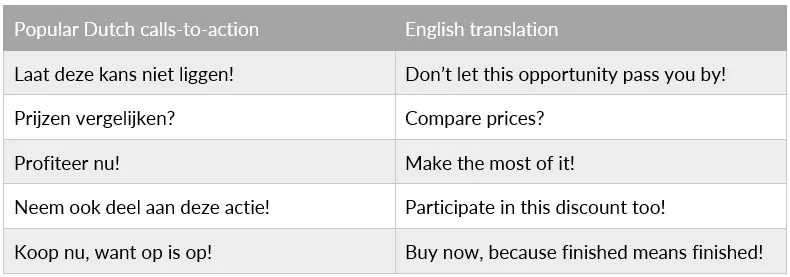
Speaking of calls-to-action, do not directly translate your calls-to-action from English, as a direct translation is unlikely to resonate and work well in the Netherlands. Instead, do some research to find out which calls-to-action are commonly used online in the Netherlands in your sector. The table below lists some popular Dutch calls-to-action.
Another area of digital marketing that is impacted by the Dutch language is dynamic keyword insertion. Dutch does not always take dynamic keyword insertion kindly, due to grammatical gender issues. While modern English does not differentiate nouns according to gender, the Dutch language still has grammatical genders (common and neuter), and the gender of a noun determines which definite article you use, and how you spell the adjective that comes before it. Dynamic keyword insertion therefore puts you at risk of producing copy that is faulty and off-putting. If you must use dynamic keyword insertion, make sure to use several templates to adapt to as many cases as possible and limit errors.
It is also important to think about your keywords. Keywords should never be translated; instead, you should always conduct local keyword research. This is because a translation will probably not produce keywords that have the most impact in the target market. Only fresh keyword research conducted by a native speaker will reveal the best keywords to target.
The e-commerce market in the Netherlands is well-developed. 76% of the total Dutch population have made a purchase using a mobile phone or the internet in the past year. Online sales are worth the equivalent of over USD 36 billion annually.
According to a study by Meltwater and We Are Social, the e-commerce categories which saw the highest levels of growth in 2023 compared to 2022 were: food with a year-on-year growth rate of 17%; furniture (spending up 16%); tobacco products (up 13%); fashion (up 11%); household essentials (up 11%); luxury goods (up 10%); beverages (up 4%); eyewear (up 4%); beauty and personal care (up 3%); electronics (up 2%); and toys and hobby (up 2%). All other categories saw a decrease in spending. DIY and hardware saw the biggest reduction in spending, with spending falling 7% compared to the previous year, followed by physical media (spending down 5%) and over-the-counter pharmaceuticals (down 3%).
If you would like to enter the Dutch e-commerce market, you are strongly advised to apply for the Thuiswinkel Waarborg trust mark. This is provided by the Dutch e-commerce association, Thuiswinkel.org. Having this trust mark displayed on your website is a sign to Dutch consumers that your website is trustworthy.
The main drivers of online purchases are key indicators as to what Dutch users value most when making their online purchasing decisions, giving you an opportunity to understand what is best to highlight in your marketing collateral and calls-to-action, so that you can convert leads into customers. Free delivery is the top driver of online purchasing behavior in the Netherlands, with 62% saying this would encourage them to buy. This is followed by next-day delivery with 45% and coupons and discounts with 36%.
From our experience helping global brands succeed in the Dutch market, we can add that the quality of a product or service is another important driver of purchasing behavior. Dutch consumers are willing to pay a little bit extra for higher quality – so long as this is within reason. And the good news for international brands is that there is no distrust when it comes to purchasing foreign products over their domestic counterparts.
Looking at e-commerce payment methods, account-to-account payments are the most popular option, accounting for 64% of online purchases. Buy now pay later comes in second place, accounting for 11% of online purchases. This is followed by credit cards with 10% and digital wallets with 10%. It is therefore essential to offer account-to-account payments as a payment option when targeting the Dutch market. The most popular account-to-account payment method is iDEAL, which was developed by the Dutch banking community.
Another important thing to remember is to ensure you are selling in the correct currency: euros (€ or EUR). This may sound obvious, but you would be surprised how many businesses see poor results simply because they have neglected to localize the currency on their website.
When creating your price labels, be aware that the Netherlands is one of the countries that uses the comma as a decimal separator, and not the point. Furthermore, the comma is not used as a thousand separator; instead, groups of digits are typically separated by a point. This is the opposite of how numbers are written in English-speaking countries. The bullet points below illustrate this by demonstrating how to write one hundred thousand euros in the English versus the Dutch way. When targeting the Netherlands, make sure that your prices follow the Dutch standard, to ensure clarity.
Alternatively, you could sell your products on an e-commerce marketplace. The most popular e-commerce marketplace in the Netherlands is Bol, followed by Marktplaats, Amazon, AliExpress and Tweakers. If you want to sell your items on an online marketplace, Bol should therefore be your first choice when targeting the Netherlands.
Once you have sold a product, you still need to get it to the customer. The most popular delivery method for items bought online is home delivery, with this being the preferred option for over 70% of online shoppers in the Netherlands. Make sure you offer this delivery method on your website (if applicable).
Be aware that there are seasonal fluctuations in the Dutch e-commerce calendar, when people are more likely to buy. The busiest times of the year in terms of online spending are seen in the run-up to the following dates: Valentine’s Day (14 February), Mother’s Day (the second Sunday in May), Father’s Day (the third Sunday in June), Sinterklaas (5 December) and Christmas (25 December). Make sure you tap into this seasonality when selling your products and coming up with your marketing materials.
The Dutch market is one that is both wealthy and digitally mature, with high levels of internet penetration and a keen openness to foreign businesses and brands. It is a strong and established market that rightfully draws the attention of many global brands. We hope this guide has given you a good starting point from which to build your Dutch success story. If you localize your strategy effectively, your digital marketing and business expansion efforts in the country have the potential to go far. Good luck!
Want to discuss how we can help your brand succeed in the Netherlands? Let’s talk!
TransPerfect Digital
TransPerfect Digital combines best-in-class AI technology with deep human expertise in global marketing, content creation, and localization. As part of the TransPerfect family – operating in a language services market valued at $75.5 billion in 2024 and projected to reach $93.37 billion by 2030 (IMARC Group research) – we bring unmatched capabilities to help global brands connect with customers across languages, cultures, and markets. Our team of 200+ digital marketing specialists works alongside data scientists and AI engineers to deliver solutions that blend technological innovation with strategic insight. We serve more than 1,000 global brands across 170+ languages and 200+ markets.