Over the last few years, artificial intelligence (AI) has completely changed how we approach performance marketing. What’s often missed is that AI is influencing results in two distinct ways, even though many people still blur the line between them.
On the one hand, there’s the AI that advertisers and marketing teams use directly: tools that let us generate copy, images, videos, headlines, and variations at speeds that would have been unthinkable before. On the other, there’s the AI that platforms apply behind the scenes. Google, Meta, TikTok, Amazon, and others use their own models to combine what we upload, predict what’s likely to work, decide who to show it to, and determine how much to charge – squeezing every last penny out of the budget.
Both layers are essential and they feed off each other, but they operate at different moments and with different goals.
If we look back at AI’s impact on the business world, things began to shift in 2023 and 2024, when anyone could open ChatGPT or Midjourney on their phone and start experimenting. But 2025 is when it got serious from a business perspective. Companies moved beyond isolated pilots and began investing in their own tools and third-party solutions, embracing AI at scale in real campaigns.
At the same time, the major platforms rolled out powerful new AI tools: Google brought out AI Max for Search and Performance Max, Meta put even more muscle behind Advantage+, and TikTok launched Smart+ along with Symphony to speed up and refresh massive amounts of content.
Many people think AI is something that only appeared in the last few years. In reality, it’s been quietly evolving for decades: from the early chess programs of the 1950s, through the expert systems of the 1980s, to major advances in speech and image recognition in the 2000s.
Still, the moment AI really exploded for the general public was with the release of ChatGPT in November 2022. Since then, adoption has been ferocious, both in everyday life and in companies. And even though we’re still only in the early stages of maturity, there are already some worrying signs of premature saturation, particularly in our sector.
When everyone uses similar tools, ads start to look and sound the same. Fatigue sets in faster, and incremental lift, meaning the customers or sales that happened because of your campaign and would not have happened otherwise, begins to erode.
The game is no longer about producing more ads. It’s about producing better ones, refreshing intelligently, keeping relevance high, injecting human soul when it’s needed, and protecting what makes your brand unique while getting the absolute most out of the platforms’ automatic engines.
Before we continue, just to be clear, what exactly do we mean by incremental lift?
Imagine you run a cake shop and one day you put up a huge sign: “Free slice of cake with every purchase!” You close the day with spectacular sales. Brilliant. But then you realize many of those customers were already coming in every day because they love your cakes. So, the key question is: how many extra customers came purely because of the sign? That number is the incremental lift. It’s the sale you actually created with your idea, not the one that would have happened anyway.
Now that that’s clear, let’s move on.
Let’s start with what AI lets us, the people on the advertiser side, actually do.
The first thing that blows you away is the sheer speed. What used to take weeks of meetings, briefings, reviews, and tweaks can now be iterated and tested in days, sometimes even hours. That gives you tremendous freedom to experiment and react in real time to what’s working.
Then there’s the scalability. If you sell in multiple countries or have a massive catalog, you can generate hundreds of tailored variations without multiplying headcount. And the best part? Dynamic personalization that adjusts messaging, imagery, or claims according to audience, intent, or device, right at the moment the user sees the ad.
But as with everything in life, it’s not all rosy. There are real risks we need to keep in mind.
The most obvious risk is homogenization. When nearly everyone uses the same tools and similar prompts, ads start to sound alike and brands lose personality. In regulated sectors such as finance, health, insurance, and pharma, the stakes are even higher. AI can generate claims that can’t be substantiated (for example, “reduces heart attack risk by 70%” with no clinical backing) or that outright breach regulations, which can lead to significant fines.
The most dangerous long-term risk, even if it’s less visible at first, is that AI is built to optimize for immediate clicks and conversions. It doesn’t understand or protect brand equity. If you focus everything on selling today, you may boost short-term results, but you can gradually erode the trust and preference people feel for your brand over time.
That said, it’s important to remember that the AI we use is only one half of the equation.
Once we upload what we’ve created, a much larger and more powerful AI takes over: the one platforms run to decide what gets shown, to whom, when, and at what price. That’s where the real match is played. Understanding how it works, and aligning with its requirements, can give you a serious competitive edge.
Once you upload your ads, the second layer kicks in: each platform’s internal AI.
Google with Performance Max and AI Max doesn’t just take your text and images. It automatically combines them, predicts which combination will deliver the best click-through rate (CTR) and relevance, adjusts bids in real time, and decides how to allocate your budget to hit the goal you set.
Meta does something similar with Advantage+ Creative. It generates variations from what you uploaded, predicts engagement, and uses internal metrics like Ad Strength to decide how much reach you get and at what cost per thousand (CPM). If your ad is seen as low-relevance or repetitive, it gets penalized with higher costs or reduced delivery.
TikTok with Smart+ and Symphony looks to maximize thumb-stop and completion rate. If the content feels fresh and hooks people, the algorithm pushes it hard. If it’s generic or people have seen it too many times, CPM rises and delivery gets throttled.
The same is true with Microsoft Ads, Amazon, and other platforms. Each has its own AI engine constantly evaluating: Is this relevant? Will it drive action? Does it deserve more or less exposure?
In short, you decide what you upload and how good it is, but they decide how much it costs you and how far it reaches. That’s why the interplay between the two layers, and understanding how to integrate them properly, is what really separates success from failure.
So far, we’ve talked about how all this works in theory and about the two layers of AI operating at the same time. But you’re probably thinking, “Okay, that’s all very well… but does it actually show up in the numbers? Is all this effort really worth it?”
Let’s look at some real data.
The benchmarks in the table below come from WordStream (2025), TheeDigital (2026), Lebesgue (2026), and Skai (2026). They reflect the observed impact in accounts that made heavy use of AI both for creative generation and automatic optimization over the past year.
Before you review the table, a couple of important clarifications:
Important Note: These are aggregated averages. Platforms tend to showcase their best results, so treat them as a solid reference point, not as an exact guarantee for your specific account.
Here’s the comparative table:
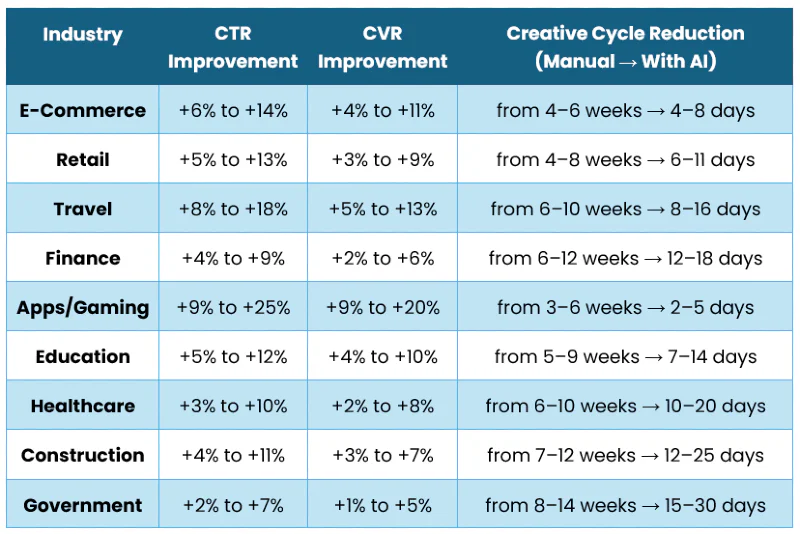
What do these numbers tell us at a glance?
The key takeaway is that every sector shows improvement, although the magnitude varies widely by business type. The effect is most pronounced in high-creative-turnover, highly competitive verticals such as apps and gaming, travel, and e-commerce, where the ability to refresh quickly and personalize at scale makes a meaningful difference. In more regulated sectors, or those with longer purchase cycles such as government, healthcare, finance, and construction, the gains tend to be more moderate, but still clearly positive and, most importantly, sustainable.
And here’s the interesting bit. These results don’t happen by chance or just because you’re generating more ads. They happen when the two layers are properly aligned (as we mentioned earlier):
That’s why it makes perfect sense to pause for a moment and look at exactly how platforms are evaluating and boosting (or penalizing) what we send them.
Let’s get into the nitty-gritty. What happens when you upload all that AI-generated (or AI-assisted) content to the platforms?
Google has always been fairly transparent about its Quality Score, the 1–10 rating that influences how much you pay per click and where your ad appears. It’s based on three main factors: expected CTR, ad relevance, and landing page experience.
Google’s internal AI (the one that powers Performance Max and AI Max) targets the first two pillars directly. It mixes and matches your text, images, and videos in combinations you might not have considered, then predicts which ones will drive higher click-through rates and stronger relevance. The result is often a higher Quality Score, lower cost-per-click (CPC), and better auction placement without increasing budget.
But it’s not just Google. Meta doesn’t give you an exact number like Quality Score, but Ad Strength, visible directly in Ads Manager, acts as its closest equivalent, evaluating your creative quality, audience relevance, and asset diversity to determine how competitively your ads are delivered. The stronger your Ad Strength, the more favorably Meta’s auction treats your ads: lower CPMs, broader reach, more efficient spend.
When you use Advantage+ Creative, the platform generates variations from what you uploaded and predicts how much engagement each combination is likely to drive, feeding the exact signals Ad Strength is built on. More creative diversity means more combinations for the system to test, which improves audience relevance scores and asset quality ratings, which in turn strengthens how your ads compete in auction.
According to Meta’s own internal research, Standard Enhancements in Advantage+ Creative delivered an average 4% reduction in cost-per-result across campaigns optimizing for link clicks, landing page views, and offsite conversions. In practice, the gains can be significantly larger. Meta has reported cases with a 56% lower cost-per-purchase and 36% lower cost-per-add-to-cart after enabling the same feature.
Meta has reported cases with a 56% lower cost-per-purchase and 36% lower cost-per-add-to-cart after enabling AI features.
On TikTok, it’s similar but with its own flavor. The algorithm prioritizes video completion rate and engagement rate as its primary creative quality signals. Smart+ and Symphony look for hooks that make people stop scrolling and watch the entire video. If you nail it, the algorithm rewards you with more distribution and lower CPM. If your ads are generic or overexposed, it penalizes you by raising costs.
Microsoft follows a similar logic. Its Quality Score uses the same three pillars as Google: expected CTR, ad relevance, and landing page experience. However, Copilot is now changing what’s possible within that framework. According to Microsoft’s own research, ads served within Copilot’s conversational environment generate 73% higher CTRs and 16% stronger conversion rates compared to traditional search, a reflection of how AI-matched, intent-driven ad experiences produce stronger engagement signals than conventional keyword targeting. Those signals feed directly into Quality Score, which means better relevance scores, lower CPCs, and stronger auction positions. Microsoft has shared advertiser case studies showing 10% CTR lifts from ads created directly with Copilot.
Ads served within Copilot’s conversational environment generate 73% higher CTRs and 16% stronger conversion rates compared to traditional search.
Amazon uses its own AI to evaluate ad relevance and listing quality, factoring in CTR, conversion rate, and listing content, to determine which ads win auctions and at what cost. The better your creative and product content align with search intent, the lower your advertising cost of sales (ACoS) and the more efficiently your budget works.
The common thread is clear: the platform’s AI improves your metrics when you feed it relevant, engaging content, but it can worsen them quickly if you give it generic, repetitive, or tired material. That’s why the trick is to use the AI in your hands to produce strong content, and then let the platform’s AI work its magic.
Now to the big question everyone is asking: do you let AI do everything, or do you still need people?
The short, honest answer is that neither extreme works well on its own in the long run.
AI (both yours and the platforms’) is unbeatable when you need pure speed and volume: large-scale variation testing, transactional campaigns, huge catalogs or multiple languages, and constant refreshing to avoid fatigue. In those scenarios, the machine wins hands down.
But when the goal shifts to building trust, truly differentiating your brand, or shaping medium-to-long-term strategy, people remain essential. Why?
Building brand equity requires a clear understanding of who you are as a brand, what your unique voice is, and what makes you memorable beyond a discount or one-off promotion. Managing regulated claims requires human judgment to navigate rules that vary by country and to avoid fines or reputational damage. And storytelling with real emotion and strategic positioning rarely comes from a prompt alone; it takes empathy, vision, and a narrative that genuinely connects.
A quick example: you ask AI to generate 50 versions of an ad for health insurance. It gives you 50 correct, fast, well-written variations. But only a person with brand judgment can look at them and say, “this one really conveys trust, that one sounds alarmist and scary, this one reinforces the closeness and calm we want.” That human filter is what makes the difference between blending in and actually connecting.
The winning approach isn’t choosing between AI and people. It’s a well-executed hybrid model: let AI generate and optimize at full speed to handle the heavy lifting, while people stay in the driver’s seat to think, filter, analyze, differentiate, protect brand identity, and decide when to say, “This doesn’t represent who we are.”
In an environment that’s becoming predictably more saturated, that combination sets you apart from competitors and helps you stand out – so much so that others start copying you.
Of course, there are nuances within this, and each industry, each category, and each country has its own rules for making it work, as we’ll see in the next section.
The key isn’t applying the same recipe everywhere. Every channel and every market has its own personality, consumption habits, and rules. And AI (on both sides) behaves differently depending on where you use it.
Each region has its quirks. The US scales with tech and Connected TV, while EMEA wins with trust and regulatory compliance. APAC exploits virality and speed, and LATAM grows with contextual e-commerce. AI isn’t magic on its own. Choose the channel, format, and approach that best fits your market, and you’ll see performance take off.
We’ve now seen how AI is rewriting the rules from both sides: what we generate and what the platforms ultimately do with our material. But all this speed, testing capacity, and personalization only matter if, at the end of the month, quarter, or year, it translates into real, sustainable growth.
The classic metrics are still essential. CTR, CVR, CPA, ROAS, AOV, Quality Score, or Ad Strength remain the daily pulse of an account. But if you only focus on those numbers, you risk celebrating results that aren’t actually bringing in new customers, but simply accelerating the ones who were already coming via other routes.
What truly separates accounts that grow sustainably from those that just post pretty numbers comes down to three metrics you need to watch closely:
So, what practical approach is working in most well-managed accounts right now?
The bottom line? If you don’t manage the three dimensions above, AI isn’t actually helping you grow. It’s just letting you move faster until you run out of runway and budget.
Artificial intelligence has transformed performance marketing. It gives us incredible speed, massive scale, and personalization that would have seemed like science fiction a few years ago. But it also creates some very real challenges: saturation, ads that all look the same, and creative fatigue that can tank performance even when everything else is perfect.
The answer isn’t to reject AI or let it run on its own. The answer is a hybrid model: let your AI generate and accelerate, let the platforms’ AI optimize and scale, and keep people at the center to curate, differentiate, protect the brand, and learn from the data.
Measuring properly (from immediate CTR right through to long-term LTV) and refreshing intelligently is what separates the survivors from the leaders.
The future doesn’t belong to whoever has the most tools, but to whoever uses them with human judgment and strategic vision. This will be an exciting, demanding year, full of opportunity for teams that find that balance.
One final thought for 2026: the brands already standing out aren’t just using AI, they’re training it with their own essence: brand guidelines, historical campaigns, real values, and a consistent tone of voice. That’s how the machine stops sounding generic and starts sounding genuinely like them.
Are you already experimenting with hybrid approaches and combining both layers of AI, or are you still trying to keep up with the flood of new tools? Have you considered a custom AI solution that actually learns your brand, instead of repeating what everyone else is doing?
If you’d like to explore how to implement a personalized approach without making life complicated, we’re here to help. Get in touch and we’ll help you take it from idea to practical reality.
Want to check out our paid media case studies? We’ve got you.

Feras is a Performance Growth Manager at TransPerfect Digital. He has over 15 years of experience in marketing and technology. He has worked for telecoms and marketing companies including Vodafone, Telefonica (O2) and Croud, as well as charities such as Save the Children and Plan International. He has worked as a Sales Manager, QA Engineer, PPC Manager and Business Strategy Analyst. Originally from Spain, Feras now lives in Wales.