

Amazon is changing how product listings are displayed. For brands, this is more than a technical update. It represents a fundamental shift in how products are presented to shoppers across desktop and mobile.
With the new title update scheduled to go live on July 27, 2026, many brands are asking the same question: Should we manually rewrite our Amazon product titles now, or wait to see how Amazon’s AI handles the transition?
Because the update hasn’t gone live yet, no one knows exactly how it will affect search performance, click-through rates, or conversions. However, we can break down the strategic implications and the options currently available so brands can make informed decisions.
The Current Situation
Today, Amazon listings can include product titles of up to 200 characters.
Because product titles remain one of the strongest signals for Amazon SEO, brands typically maximize that space by incorporating as many relevant search terms as possible. At the same time, most prioritize the first 75 characters to improve visibility and reduce truncation on mobile devices.
What’s Changing?
Beginning July 27, Amazon will transition to a modular title structure designed to better balance search optimization with the mobile shopping experience.
Rather than combining every product detail into a single title, the new format separates essential product identification from supporting information.
- Main title (75 characters): Contains only the essential information needed to clearly identify the product. Promotional language is not permitted.
- Item highlights (125 characters): Provides additional descriptive information, such as materials, intended use, key features, or other product attributes, using comma-separated phrases.
You can find a more detailed breakdown of Amazon’s guidelines on main titles and item highlights here.
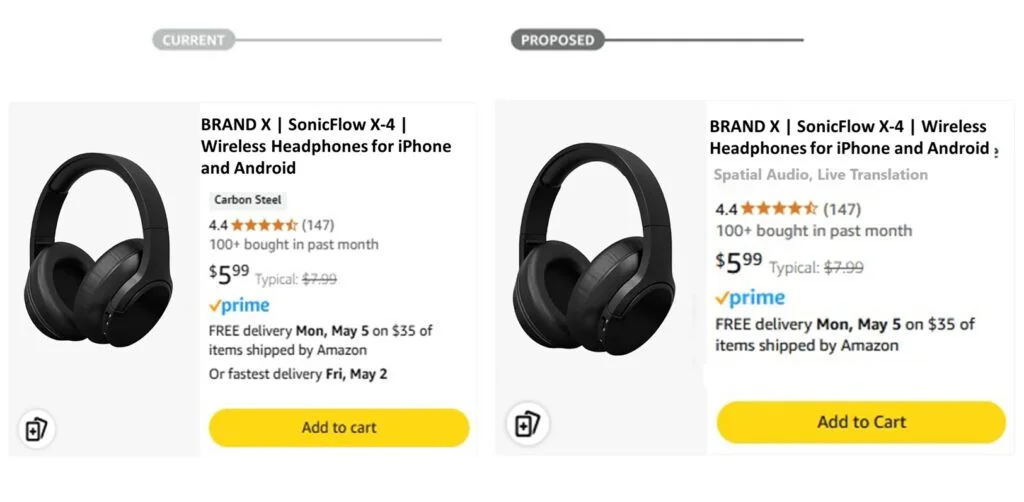
The graphic below shows how titles will change from the current format to the new one.
Search results:
Product page:
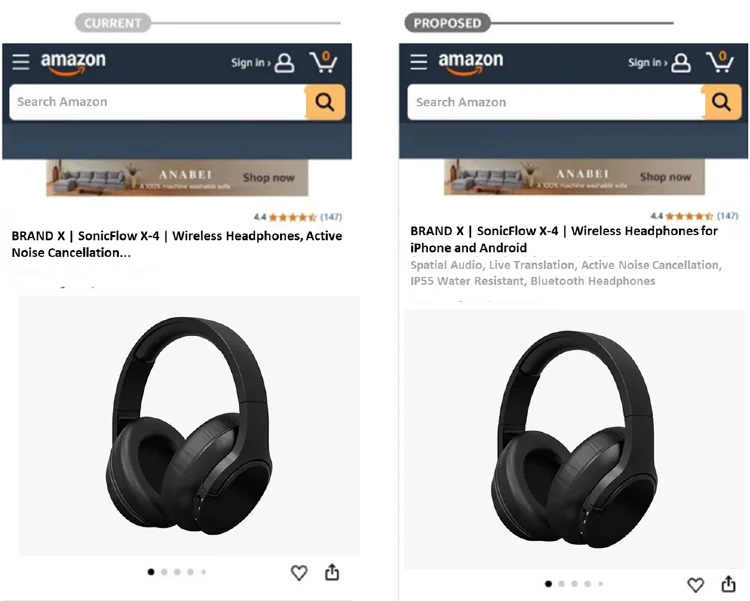
Early reports suggest mobile interfaces may display only the first 30 or so characters of the item highlights, although Amazon hasn’t confirmed this behavior.
Regardless, one thing is clear: if brands don’t define these fields themselves, Amazon’s AI will.
What’s the Impact of This Change?
While the overall 200-character limit remains, the way those characters are used is changing significantly.
- Visibility: The combined 200-character structure will remain critical for indexing, ranking, and overall Amazon SEO. However, the 75-character main title becomes the primary opportunity to establish relevance, making keyword prioritization more important than ever.
- Click-through rates: While the main title continues to drive discoverability, item highlights may play a much larger role in persuading shoppers to click by providing additional context and value.
- Conversions: Item highlights could evolve from a passive data field into an active conversion tool. If mobile devices display only the opening portion of this field, those first few words may become the deciding factor in whether a shopper explores the listing further.
What are the International Implications?
This update applies across all of Amazon’s global sites, and if you’re selling into multiple markets, localization becomes an important consideration.
Ensuring that the most important information appears within the first 30 characters, where titles are most likely to be truncated, while also optimizing the full 75-character title is essential—but much trickier in languages like German and Turkish than in English. Leading with intent-matching phrases should be a priority, but those phrases will vary by market and need to be adapted for the new format.
Amazon’s AI rewrites could also overlook compliance considerations. Is there required compliance language that must be included, or trademark conflicts that need to be avoided? These issues are market-specific and can have a serious business impact if missed.
What Should Brands Do Before July 27?
Although the long-term impact of the Amazon title update will only become clear after launch, brands effectively have two options as this transition rolls out:
Option 1: The “Wait and See” Approach
You can choose to do nothing. Amazon will automatically restructure your existing product data to fit the new requirements, splitting your current copy into the new main title and item highlights fields.
- Pro: Minimal resource investment.
- Con: You lose control over how your products are presented. Amazon’s AI may prioritize keywords or highlight selling points in ways that don’t align with your brand voice, merchandising strategy, or customer intent.
Option 2: The Proactive Approach
You can populate the new backend fields before the go-live date.
- Pro: You maintain full control over how products are indexed, displayed, and ultimately perceived by shoppers.
- Con: Requires planning, content strategy, and manual updates across your catalog.
Our Strategy: The Modular Matrix
We recommend taking a proactive approach, but only with a well-defined strategy. Simply populating the new fields is unlikely to deliver meaningful results.
Because the 75-character main title is largely reserved for core product identifiers, there’s limited room for benefit-driven messaging. The item highlights therefore become increasingly important, particularly if only the opening characters are visible on mobile devices.
To address this challenge, we suggest a two-stage process built around segmentation and matrix construction.
Stage 1: Segmentation
Begin by categorizing product groups based on primary variables such as:
- Target audience: Who is the product intended for?
- Category and usage: What are the industry benchmarks for this product and how does the consumer actually use it?
- Price: How much does it cost?
Stage 2: Matrix Construction
Once products have been segmented, create priority modules for each group. These modules establish the optimal order of information within the item highlights.
For one segment, technical specifications may deserve top priority. For another, emotional benefits, gifting potential, or lifestyle applications may resonate more strongly.
This structured approach ensures the opening characters—which may be all mobile shoppers initially see—are optimized for shopper intent, while the remaining space continues to support SEO through strategically placed search terms.
Rather than simply filling in fields, brands intentionally shape how products are presented at the exact moment customers begin their purchase journey.
Moving Forward
This framework should be viewed as a starting point rather than a definitive playbook. Once the Amazon title update goes live, real performance data will provide a much clearer picture of what works.
Our recommendation is simple: develop a thoughtful strategy for your highest-priority products, monitor results closely, and be prepared to iterate as new insights emerge.
Brands that establish control over their product messaging today will be in the strongest position to refine and optimize their approach as the new title structure matures.
TransPerfect Digital helps brands optimize Amazon product titles, improve Amazon SEO, and adapt to marketplace changes with data-driven strategies. Contact our team to discuss your Amazon strategy.
Explore More
- Read our blog post, 5,500 Data Points Later: The New Hierarchy of Amazon Ranking and Conversion.
- Explore our SEO case studies to see how we’ve helped brands improve organic performance.
- Check out our guide, How to Develop an International SEO Strategy.