

A surprisingly common assumption persists in global marketing: Build one strong content strategy, translate it, and roll it out everywhere.
That approach has never worked particularly well. Individual markets have always required adaptation, but in the age of AI-driven discovery, the cost of ignoring those differences is higher than ever.
Every market has its own mix of dominant search engines, AI search tools, user behaviors, and regulations, and a global content strategy needs to reflect all of them. What works in one market can underperform, or even backfire, in another.
For example, Google-led strategies need to be adapted in markets such as China and South Korea, where local ecosystems such as Baidu and Naver play a much greater role in discovery. Financial or medical regulations also vary widely between countries, something that needs to be carefully reflected in all content.
Why Global Content Strategies Can Fail
1. Different Engines, Different Ecosystems
Many content strategies are built around two assumptions: people search on Google, and people ask ChatGPT.
But outside of a handful of markets, neither is fully true. China is a good example. Google is blocked, and the AI landscape has evolved largely independently from the West. Discovery happens across a mix of local search engines, AI assistants, and super apps, with platforms such as Baidu, WeChat, Doubao, DeepSeek, Kimi, Quark, Yuanbao, Qwen, and ERNIE Bot all competing for user attention. This is an entirely different retrieval ecosystem, where local content, publishers, and trust signals matter just as much as global search engine optimization (SEO) best practices.
Can you optimize for one large language model (LLM) versus another? Only to a point. The bigger lever is market, not model. Think of it in three layers:
- Universal AI optimization: Clear answers, comprehensive coverage, solid technical SEO, and clearly defined brand, product, and organizational entities help all LLMs.
- Search ecosystem differences: Each AI platform retrieves information differently.
- Local market differences: Which engines matter, which sources are trusted, and how people phrase queries vary far more by country than by model.
Although the optimization principles remain largely universal, research shows that different AI platforms retrieve information from different sources. Some rely more heavily on search indexes, while others place greater emphasis on publisher content, structured knowledge, community discussions, or proprietary retrieval systems.
For brands, this doesn’t mean creating separate content strategies for every AI model. Instead, it means understanding which sources influence the AI platforms your audience uses and strengthening your visibility across those ecosystems. Monitoring citations across multiple AI platforms helps identify where your content is being discovered, and where gaps remain.
The strategy: optimize for AI retrieval and citation, then adapt by market.
2. Trust and Behavior Are Local
AI systems don’t just surface pages. They also determine which sources and brands to reference and cite. Building that visibility requires a localized approach:
- Trust is regional: English press coverage may carry little weight with a Chinese-language AI that relies on local media, forums, and directories.
- Consistency builds trust: If your brand name, description, or contact details differ across websites, AI can treat that as a red flag and either omit you or serve outdated information.
- Query styles differ: Some markets use short, keyword-style searches. Others prefer long, conversational questions. In South Korea, Naver has evolved beyond a traditional search engine, with AI-powered features such as AI Briefing, which summarizes answers directly within the search results, and AI Tab, which provides a conversational search experience that pulls together results from search, shopping, places, blogs, and forums. Because Naver continues to prioritize its own ecosystem of blogs, forums, and local publishers, brands need to optimize for the South Korean search ecosystem, not simply translate content that performs well on Google.
In this video, Vivian Ma, Director of Digital for APAC at TransPerfect, explores AI and LLM adoption in markets such as Japan and China, highlighting how usage rates and preferred platforms can vary dramatically. For example, in Japan, AI adoption is only around 27%, with ChatGPT being the most popular platform. Meanwhile, AI adoption in China is around 82% and local platforms like DeepSeek and Doubao lead:
Note: This interview with Vivian was recorded earlier this year, and in a real-life illustration of how quickly this industry moves, the exact stats have already shifted! This is why you must stay on top of market intelligence for each country you’re targeting.
3. Language, Culture, and Compliance Don’t Scale Globally
You need to think at a market level rather than relying on a regional approach.
- Language depth: Language isn’t simply translation. Search intent, terminology, tone, and local context all vary by market, and AI systems are increasingly sensitive to those differences. Direct translation often feels generic or off.
- Cultural nuance: Values, taboos, and consumer expectations differ from country to country. Content created without these local nuances in mind can miss cultural norms and trigger backlash.
- Regulatory fragmentation: Each market has different AI, data privacy, and advertising laws. Translated source content can easily become non-compliant once it crosses borders.
What to Do Instead: A Market-by-Market Framework
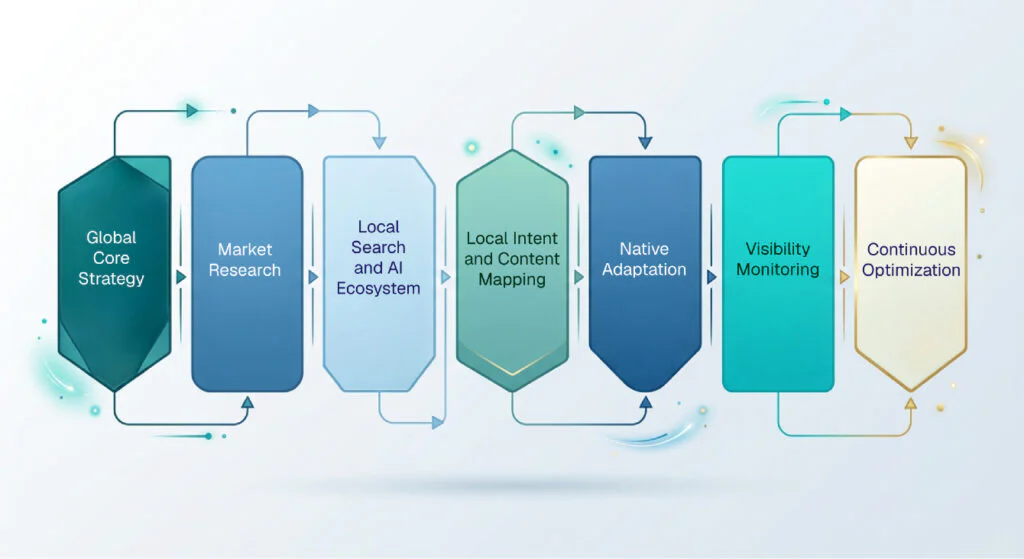
A strong global strategy starts with a shared strategic core, but the research and execution need to reflect how people discover, evaluate, and trust information in each market.
1. Map the Local Discovery Ecosystem
Before creating content, identify which search engines, AI platforms, social networks, communities, and local content platforms influence discovery in the market. Understand which platforms people use for research, which sources they trust, and how those ecosystems feed into AI-driven discovery.
2. Identify Local Trust Signals
Look beyond search rankings. Map the local publishers, industry websites, forums, directories, review platforms, experts, partners, and other sources that influence how your brand is perceived and cited. Consistent branding and information across these sources help strengthen trust.
3. Map Local Search Intent and Content Needs
Don’t simply translate an existing keyword list. Research how people in the market phrase questions, what terminology they use, what information they need at different stages of the customer journey, and where competitors or local publishers already have strong visibility.
4. Adapt the Global Content Core Natively
Keep the core brand proposition and key messages consistent, but adapt examples, evidence, terminology, tone, FAQs, references, and calls-to-action for the local audience. The goal is content that feels created for the market rather than translated for it.
5. Measure Visibility and Refine
Track traditional and AI search visibility alongside AI citations and mentions, traffic, engagement, and conversions by market. Review which sources are influencing discovery and use those insights to identify gaps in content, technical performance, or authority.
To recap, a useful workflow for a successful global content strategy is:
Real-Life Case Study
Here’s how this approach looks in practice. Our TransPerfect Digital team recently applied it to a project for Medibank, an Australian private health insurance company.
The Challenge
Medibank was preparing to launch a new health insurance product targeting overseas visitors from China and India. The product involved complex rules and policy benefits, creating a need for content that was accurate while remaining user-friendly, digestible, and accessible across distinct audience profiles.
The company also needed a landing page structure that could be smoothly implemented in AEM and optimized for both traditional SEO and generative engine optimization (GEO).
Our Solution
Our team conducted market and keyword research along with search engine results page (SERP) analysis across Google and Baidu. Using those insights, we developed a strategic content layout that balanced informational content with conversion-focused elements.
We also conducted a user experience (UX) review of SERP patterns and competitor benchmarks to determine the content hierarchy, call-to-action placement, and component structure.
The Results
In just 60 days, we achieved:
- 80% increase in unique visitors from organic search
- 75% of unique visitors viewed a health insurance product
- 13% conversion rate, more than double the typical digital conversion rate
What a Global Content Strategy Really Means
A “global” content strategy was never supposed to mean one strategy that works everywhere unchanged.
It means establishing a shared set of principles around content quality, technical accessibility, and consistent brand information, then tailoring the details market by market.
Brands that invest in market-specific visibility will have a real advantage over competitors still relying on a one-size-fits-all strategy.
Need support building a global content strategy tailored to the needs of each market? Our team at TransPerfect Digital would love to help. Get in touch today.
Explore More
- Learn why technical SEO is increasingly important for AI visibility in From Crawlability to AI Visibility: Why Technical SEO Matters More Than Ever.
- See these strategies in action by exploring our content marketing case studies.