

What 132 Marketing Leaders Are Actually Prioritizing
At DigitalNEXT London, one thing stood out: This was not an AI 101 crowd. The pre-event survey suggested as much, and the conversations and questions in the room confirmed it.
Marketers from search, digital, e-commerce, creative, content, and media backgrounds came together to explore AI in marketing and its impact. The mix of attendees reflected a growing reality: Marketing disciplines are increasingly converging.
Survey responses helped shape the agenda, with sessions addressing attendees’ priorities and the areas they wanted to understand better.
Let’s explore the data from 132 global marketing leaders and how it aligns with insights shared during the event. Respondents could select multiple answers, so percentages may total more than 100%.
AI Adoption Isn’t Up for Debate
The survey revealed that just 3.8% of respondents are not yet using AI, while 5.3% are unsure how it’s being used. Meanwhile, 44.7% are experimenting with a few tools, and 24.2% are building custom agents. In this sample, AI adoption is nearly universal. What’s more revealing is how widely AI integration varies.
Nearly a quarter of respondents are actively building custom agents and solutions, yet only 6.8% say AI is central to operations. Teams are developing capabilities long before AI becomes integral to their workflows, suggesting many organizations are still experimenting, testing, and figuring out what works.
Some respondents selected multiple answers when asked, “How is your team currently using AI?” This suggests that adoption isn’t uniform across functions. One group may be experimenting, another may be using AI in production, and another may have barely started. Add vendors and external partners to the mix, and the complexity grows. Fragmentation is real.
What Are the Priorities for Marketing Leaders?
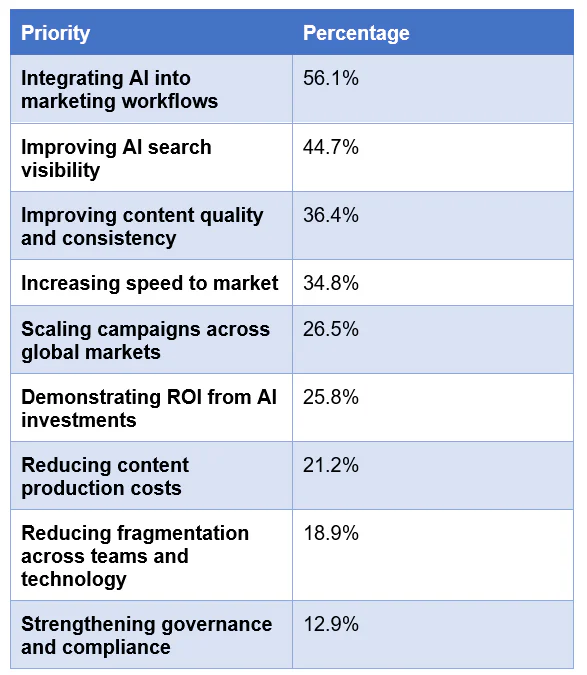
Respondents selected an average of 2.8 priorities, highlighting how leaders are managing multiple initiatives across internal processes and external marketing activities.
What does this tell us?
Quality and speed outweigh cost reduction: While lower costs may be a benefit, the primary goal is to do more, better and faster.
AI search visibility is high on the agenda: Brands want to be visible wherever customers turn for information. How to achieve that visibility is less clear.
ROI justification ranks relatively low: Are teams already convinced of AI’s value? Are investments still relatively modest, or is proving ROI simply difficult? The answer may be a combination, but it clearly isn’t the biggest priority.
Solving fragmentation isn’t a high priority: Our conversations with global enterprise clients suggest that fragmentation across teams, vendors, and projects is one of the biggest barriers to effective AI implementation. Yet relatively few respondents are prioritizing it.
Digging Deeper: Where Are the Gaps?
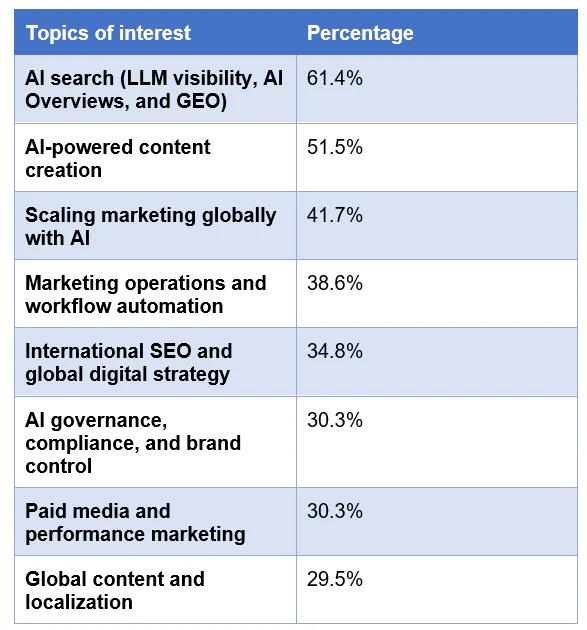
We also asked attendees what they wanted to learn. Comparing their priorities with their learning interests reveals some interesting gaps.
Here’s how the topics ranked:
Three areas stood out when we compared priorities with learning interests. While the learning question focused specifically on the event agenda, the differences offer a useful indication of where attendees are seeking greater understanding.
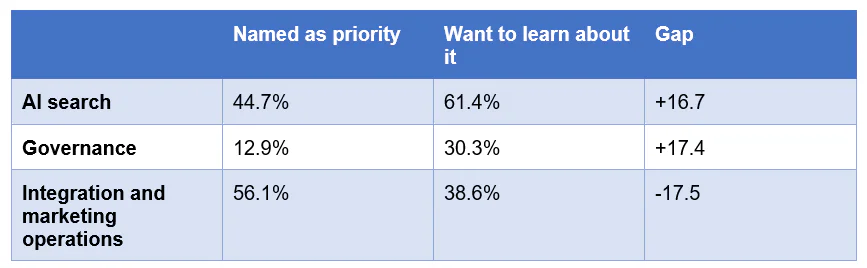
For AI search and governance, interest in learning exceeds stated priorities. This suggests that teams recognize the importance of these areas but may not yet feel equipped to act confidently. Given how quickly the field is evolving, that’s hardly surprising.
Integration tells a different story. Bringing AI into marketing workflows is the top priority, yet marketing automation and operations ranked fourth among learning interests. One possible explanation is that teams view integration primarily as a technology challenge: Find the right software, and the job is done.
TransPerfect Digital’s Mario Lenoci challenged that thinking in his introduction: “Orchestrate your agents the way you’d orchestrate your teams.”
Buying a tool is the easy part. Who owns the output? Where do approvals sit? What happens when four teams automate the same step in four different ways?
This is why fragmentation matters. Too many uncoordinated AI initiatives can create inefficiencies and introduce unnecessary risk.

The Governance Gap
Governance rarely inspires excitement, which may help explain why only 12.9% cite it as a priority. Yet more than 30% wanted to learn about it, a gap of 17.4 percentage points, comparable to the gap for AI search.
Teams aren’t necessarily ignoring governance. They may simply be postponing it. The consequences become apparent when organizations attempt to scale.
With 24.2% respondents already building custom agents, capabilities are advancing faster than the controls needed to manage them. Organizations need to close the gap.
Governance should be a top priority. Without appropriate controls, scaling AI and securing approval for enterprise use become significantly more difficult. The risks to brands, reputations, and growth are too great to overlook.
A session led by Roisin Devine from Kellanova demonstrated why this matters. She showcased impressive results from personalized, interactive campaigns made possible through cross-functional collaboration, clean and standardized data, and clear governance.
The Three AI Themes
Shane Madden, VP of TransPerfect Digital, opened with three themes that resurfaced throughout the day.
AI Enablement
AI enablement starts with governance and infrastructure. It may not be glamorous, but it’s essential to success. Data integrity, process alignment, and reducing fragmentation across tools and teams provide the foundation for scaling effectively.
AI Search and Discovery
At 61.4%, AI search generated the greatest interest among attendees. Brands are eager to understand how and where they appear across LLMs, but visibility is only the beginning.
Julie Franck of TransPerfect Digital and Antonia Breitenfellner of Peec AI emphasized the importance of putting that visibility data to work. Interpreting it in the context of a brand’s audience and business goals is what drives meaningful results. Doing so requires human expertise and nuance.

Julie and Antonia, along with Mike Bagliebter of Bluefish, also stressed the need for cross-functional alignment and a holistic strategy. Channel silos no longer work.
Both Mike and Fred Pearce of Podean discussed the rise of agentic commerce. They highlighted the importance of aligning organic and paid strategies, maintaining consistency across content, and continually measuring and refining performance.
AI Content and Marketing Operations
This theme speaks directly to the 56.1% who prioritize integration, exploring the practical impact of AI-enabled content and marketing automation.
Edouard Lemaire of Fairmont Hotels highlighted personalization as a valuable AI use case, from hyper-segmented audiences and device-specific content to real-time targeting that reaches customers at the right moment. However, he cautioned that AI should enhance rather than replace human creativity. Emotion and the luxury experience remain paramount and cannot be outsourced to AI.
Harry Thakkar of Avatria reinforced this point with a practical framework for AI-driven personalization. Start with one customer experience, use AI to interpret intent and context, apply a rule that addresses that intent, and measure the outcome. From there, incorporate new insights and adapt the approach to scale while maintaining relevance for each customer.

Danielle Guenther of Amazon.com offered another perspective, sharing how integrating AI into the linguistic QA process significantly reduced end-to-end time and costs. Rather than removing humans from the process, AI improved efficiency and effectiveness. It’s a compelling example of practical implementation.
Across the sessions, speakers consistently emphasized the importance of reliable data, governance, and appropriate guardrails to improve outcomes and reduce risk.
So What Is Your Priority?
Brands of every size should be asking this question in the context of their business goals and growth plans.
The adoption of AI in marketing is no longer up for debate. Nine in ten respondents are using or exploring AI in some capacity and nearly a quarter are building custom agents. Yet only 6.8% consider AI central to operations. Bridging that AI integration gap will be a major focus for many businesses over the next 12 months.
Much of that work isn’t glamorous. It involves determining who owns the output, which data agents use, where approvals sit, and how to reduce fragmentation across teams, tools, and channels. These decisions will determine whether AI becomes an integral part of operations or remains a collection of isolated pilots.
The organizations that scale AI successfully won’t be the ones with the most tools. They’ll be the ones that make those tools work together, and protect their brands while doing so.
Explore More
- Find out more about TransPerfect’s Global Content Operating System, Aura, and how it can operationalize AI for international brands.
- Check out our upcoming events.
- Read our blog post Agentic AI in Action: Scaling AI Across the Marketing Lifecycle.
- View our AI case studies showcasing work we’ve done for clients.