AURA — Strategic Positioning Document
I. The One-Liner
AURA gives global brands control of their content lifecycle — what gets created, localized, approved, deployed, and measured, across every market, every agency, and every channel, from a single platform. That's what a Global Content Operating System (GCOS) is. AURA is the first one.
What Problems Does AURA Solve?
Three problems. Every CMO we talk to owns at least one of them.
1. Control
I don't know what content is live globally, who approved it, or whether it's compliant.
- No one can answer the basic question: what is live, in which markets, approved by whom, and when?
- Legal review is a manual bottleneck that adds weeks to every campaign. In regulated industries, a single miss is a legal problem, not a brand problem.
- Every agency interprets brand guidelines differently. Tone, visuals, and messaging drift across markets with no central enforcement.
- Teams are adopting AI tools on their own — no brand governance, no compliance guardrails, no audit trail.
2. Speed
Production is too slow and too expensive.
- Teams juggle 10+ disconnected tools for images, video, copy, and ads — none of them connected to each other or to the brief.
- Too much time is spent coordinating agencies, chasing deliverables, and managing vendors instead of doing actual marketing.
- Content that should be locally adapted gets translated instead — technically accurate, culturally flat, and slower to produce than it needs to be.
3. Evidence
I can't prove what's working or where to put the next dollar.
- Every channel inflates its own ROI. Meta's pixel credits Meta. Google's reports credit Google.
- No one has unbiased attribution across the full content lifecycle — only self-reported metrics from platforms with a financial stake in the outcome.
- Budget decisions are made on contested data, and underperforming campaigns keep spending.
For brand holding companies, these three problems don't add up — they multiply. Not one fragmented stack, but dozens. The inefficiency scales with every brand added to the portfolio.
II. The Problem
The reason no one has solved this is structural. The full content lifecycle is fragmented across six categories of tool and vendor — none of which has any incentive to connect to the others:
| Function | Current Owner |
|---|---|
| Research & Insights | Separate tools, CDPs |
| Content Creation | Agencies + AI tools + brand strategy firms |
| Localization | Fragmented vendor ecosystem |
| Compliance & Regulatory | Legal workflows (where everything stalls) |
| Publishing & Media | CMS, media tools, holdco platforms |
| Performance & Optimization | Analytics platforms (siloed per channel) |
Salesforce owns customer data. Adobe and brand agencies own creative briefs. Omnicom, Publicis, WPP own publishing, media, and optimization through independent holdco models. CDPs own audience data. Every one of them reports into their own dashboard with their own metrics that conveniently credit themselves. Nobody orchestrates the full cycle — because no single player has ever had an incentive to.
III. What's Needed — A Global Content Operating System
A GCOS that:
- Orchestrates creation, adaptation, deployment, and optimization across every market
- Ensures content is correct, culturally relevant, and compliant
- Provides faster, more effective compliance and regulatory review
- Optimizes content from the last mile — market-ready and performance-tuned
- Gives leadership a complete audit trail — what went live, in which market, approved by whom, and when
IV. What AURA Is
A client-owned Global Content Operating System with four pillars:
Pillar 1: Orchestrate & Comply — Content Lifecycle Management
- The compliance and lifecycle audit trail — who approved what, in which version, for which market, and when. No DAM tracks this; no agency platform owns it.
- Compliance and regulatory automation — faster review, full audit trail, zero off-brand assets reaching market.
- Localization orchestration — not just translation, but culturally adapted content at scale via TransPerfect's 30+ year language infrastructure.
- Version control and approval workflows across brands, markets, and agencies.
Pillar 2: Create — Multi-Model Creative Studio
- Generate images, video, audio, documents, presentations, and code — all from one workspace.
- 10+ AI models (OpenAI, Google, xAI) — pick the best engine for each job.
- AI agents trained per brand — loaded with guidelines, tone of voice, visual standards, and compliance rules.
- Per-project asset library with full history and versioning.
Pillar 3: Deploy & Optimize — Channel Execution & Performance Intelligence
- Push creative campaigns directly into digital marketing channels: Meta, Google, LinkedIn, TikTok, Reddit.
- Cross-platform competitive ad intelligence — see what competitors are running.
- Channel-neutral performance intelligence. Every channel inflates its own ROI to justify its own spend. AURA collates data from all channels into a single unbiased view — something no channel would ever offer. Position-based attribution replaces platform-based attribution.
- Neutral signal synthesis. Meta's pixel, Google Analytics, LinkedIn Insight Tag, Claritas, and every identity or measurement vendor each drop their own tag and report into their own dashboard — with their own attribution model that conveniently credits them. AURA operates above all of it: a single neutral intelligence layer that ingests signals from every pixel, every tag, and every data partner and synthesizes them into one unbiased view of what is actually working. No channel conflict. No media arbitrage. No platform with a stake in the outcome.
- Cross-channel spend optimization. Enterprises are flooded with channel data but still can't answer: "Where should the next dollar go?" AURA provides the neutral intelligence layer to make smart allocation decisions across competing channels.
- Identity graph enrichment. AURA connects anonymous performance signals to enriched audience data — demographic, behavioral, and psychographic — through third-party data partnerships. This closes the loop between who saw what content and who actually converted, at a level of precision that no single-platform pixel can provide.
- Cost tracking and usage analytics per project and per brand.
Pillar 4: Watch — Continuous Competitive Intelligence
Most platforms help you manage your content. AURA also watches theirs.
- Automated press monitoring. AURA runs a daily recon cycle for each project — searching Perplexity across every watched competitor and industry signal. New articles are found, deduplicated at the story level (press release syndication = one story, not twenty), and stored with full metadata.
- AI-powered analysis vs. your positioning. Each new story is analyzed by Claude against the project's own positioning context — the same brief AURA built from your product documentation and competitive comparisons. The output: a summary, an impact rating (🌶️🌶️🌶️ hot → warm → mild → none), and a specific proposed action.
- Proposed actions are operational, not advisory. AURA doesn't just flag news — it recommends what to do: adjust positioning, update the competitive matrix, buy a competitor's brand keywords, draft a counter-campaign. Every recommendation is grounded in the project's actual competitive brief.
- A reviewer workflow built in. The back-office feed surfaces analyses sorted by heat. Teams accept, dismiss, or escalate — and accepted analyses flow directly into campaign briefs. This closes the loop from market signal to content action.
- Same infrastructure, every client. The recon framework is generic — AURA runs it for AURA, and every client project can run it for their own category. A pharma client watches FDA announcements and competing drug launches. A CPG client watches private-label entrants and ingredient trend stories. The competitive intelligence layer becomes a platform upsell, not a bespoke service.
Example: A new Austrian food storage brand enters the German market where AURA is managing Ziploc's content. AURA's recon spots the press release within 24 hours, identifies it as a competitive threat, proposes buying the new brand's keywords, and drafts three comparison social posts — ready for review.
V. Why Now
- AI explosion. Content volume is increasing faster than any team can manage manually. The tools exist to produce assets at speed — but without orchestration, speed creates chaos.
- Global complexity. More markets, more regulations, more languages. The compliance surface area is expanding faster than teams can manage manually.
- Performance pressure. Every dollar must show ROI. Committee-based decision-making demands data, not intuition.
- Measurement is broken and everyone knows it. Advertisers are running Meta pixels, Google Analytics, LinkedIn tags, and third-party identity vendors simultaneously — and getting four different answers about what drove the conversion. The walled gardens have made this worse, not better. Demand for a neutral measurement layer — one with no conflict of interest — has never been higher.
- Protocol-level interoperability has arrived. MCP (Model Context Protocol) didn't exist 18 months ago. Now Adobe, Salesforce, and the major AI vendors are shipping MCP surfaces. For the first time, an orchestration layer can speak to every tool in the stack via an open protocol — and expose its own capabilities the same way. The plumbing for a true GCOS exists.
- Category white space. Everyone is building AI content tools. Nobody has built the brand-owned orchestration layer that makes them all work together. This is a new category — and no one currently owns it.
VI. What Makes AURA Different
| Point Tools | Agency Platforms | AURA | |
|---|---|---|---|
| Content lifecycle orchestration | ❌ | ❌ | ✅ System of record — creation through optimization |
| Compliance & regulatory automation | ❌ | Manual | ✅ Automated review, full audit trail |
| Agency-agnostic platform (brand owns it; any agency can use it) | N/A | ❌ (captive) | ✅ Agency-agnostic — client-mandated, not agency-owned |
| Multi-model AI creative | ❌ | Limited | ✅ Image, video, audio, docs — 10+ models |
| Localization at scale | Separate tool | Separate vendor | ✅ Native — 30+ years of language infrastructure |
| Channel deployment | Separate tool | Partial | ✅ Native push to Meta, Google, LinkedIn, TikTok, Reddit |
| Neutral signal synthesis (cross-pixel BI) | ❌ | ❌ (platform-inflated) | ✅ Ingests all pixels/tags, no channel conflict of interest |
| 140+ integrations | ❌ | Limited | ✅ CRM, MT, market intel, vendor mgmt via XAPIS |
| Open protocol surface (MCP in/out) | ❌ | Partial (consume only) | ✅ Both — consume any MCP, expose AURA as MCP |
| Competitive intelligence (press monitoring + AI analysis) | ❌ | ❌ | ✅ Daily recon: story dedup, pepper-rated feed, actionable proposals |
VII. Where AURA Sits in the Market
AURA occupies a distinct layer in the marketing stack — one that no holdco platform or content management system covers. Two competitive frames make this clear.
Control of Spend vs. Control of Content (Holdco Platforms)
The global marketing stack divides into two distinct control planes. Holdco platforms like Omnicom's Omni control where money goes. AURA controls what gets created, approved, and deployed. These are complementary, not competitive.
| Omnicom (Omni + media stack) | TransPerfect AURA | |
|---|---|---|
| Controls | Where money goes | What gets created, localized, and deployed |
| Optimizes | Paid reach, frequency, performance | Content production → translation → compliance → publishing |
| Owns | Audience data + identity graphs | Language, market nuance, and regulatory readiness |
| Monetizes via | Media arbitrage + efficiency gains | Content velocity + global scalability |
Why this distinction matters
- Holdco platforms are captive. Omni, Publicis CoreAI, and WPP Open each serve their own agency network. A brand that works with multiple holdcos — which most global enterprises do — cannot use any one of them to govern the content lifecycle across all their agency partners.
- Spend optimization without content governance is incomplete. Omni can place the right ad in front of the right person. It cannot ensure that ad is compliant, on-brand, culturally adapted, and approved for that market. AURA can.
- AURA is the layer that survives agency transitions. When a brand moves its media account from WPP to Omnicom — as IBM just did — every piece of content built inside the old agency's systems has to migrate or be rebuilt. If the brand owns a GCOS, the agency change doesn't touch the content infrastructure.
- Together, they complete the picture. Holdcos optimize the buy side. AURA orchestrates the make side. A brand running both has end-to-end control: what gets created, where it goes, and how it performs.
System of Record vs. System of Execution (Adobe / DAM Platforms)
Enterprise brands that run Adobe Experience Manager (AEM) or similar DAM/CMS platforms often ask where AURA fits. The answer: Adobe is the system of record for content at rest — it manages assets, experiences, and published pages. AURA is the system of execution for content in motion — it governs how content is produced, scaled, and optimized across markets before it ever reaches AEM.
Adobe's footprint is expanding fast — AEM, Firefly, GenStudio, Express, and now SemRush (acquired April 2026). Each is a strong product. Together they are a portfolio of point tools, not an orchestration layer. The more Adobe consolidates the marketing stack under its own roof, the stronger the case for a client-owned GCOS sitting above it: one workflow that uses Adobe (and any other vendor) as components, rather than asking the brand to wire those components together themselves.
The strongest version of the Adobe argument is Express + Adobe Assets — Adobe's design tool coupled with its DAM (the cloud frontend of AEM Assets). That combination covers creation, storage, brand kits, asset versioning, and approval workflows. It is the closest Adobe-stack analog to AURA. Five gaps remain decisive: (1) regulatory compliance automation — Assets has approval workflows but not five-step regulatory review with risk scoring and audit trails for pharma or financial services; (2) localization at scale — Assets stores localized variants but does not generate them, with no in-language authoring or Tower-equivalent infrastructure; (3) channel-neutral performance — Adobe sells Adobe Analytics and Adobe Advertising, so neutrality across Meta, Google, LinkedIn, TikTok, and Reddit cannot live inside it; (4) multi-brand portfolio architecture — per-brand isolation across a holdco's portfolio is a different shape than a DAM with folders; and (5) vendor and model agnosticism — the combo locks the brand into Adobe end-to-end (Firefly only, Adobe Analytics only), where AURA orchestrates across vendors, models, and agencies. For a single-brand, Adobe-only marketing organization in a non-regulated category, Express + Assets may be enough. For holdcos, regulated industries, or any brand running multiple agencies and tools, the gaps above are why a GCOS exists.
| Adobe (AEM + DAM) | TransPerfect AURA | |
|---|---|---|
| Role | System of record — content at rest | System of execution — content in motion |
| Controls | Published assets, experiences, pages | How content is created, scaled, and optimized |
| Strength | Content management and delivery | Content production and governance |
| Localization | Relies on external vendors / manual workflows | Native — in-language authoring, not translation |
| Compliance | Not natively addressed | Automated review, full audit trail, governance built in |
| Optimization | Post-publish analytics | Real-time SEO + AI/LLM visibility optimization |
| Measurement | Page-level metrics | Cost per asset, content velocity, performance-to-outcome |
Where AURA adds value that Adobe doesn't cover
- Content production at scale. AURA replaces fragmented agency and manual processes with AI-driven workflows, enabling teams to produce more content without proportional headcount growth.
- SEO + AI visibility optimization, orchestrated end-to-end. Adobe's April 2026 acquisition of SemRush gives AEM a powerful SEO and intelligence layer — but it remains a separate product alongside Firefly, GenStudio, and Express. AURA optimizes content in real time for both traditional search and emerging AI/LLM visibility (AI Overviews, Copilot) inside the same workflow that handles creation, compliance, and localization — not as a downstream report from a sibling tool.
- Multimarket, in-language authoring. Rather than translating English content, AURA generates native, market-specific content aligned to local search behavior and intent — improving performance across growth markets.
- Workflow orchestration and governance. AURA connects research → creation → compliance → publishing into a single governed workflow, reducing dependency on multiple teams and eliminating production bottlenecks.
- Performance ownership and measurement. AURA ties content production directly to outcomes — tracking visibility, engagement, and cost per asset — enabling continuous optimization rather than one-time publishing.
In short: Adobe manages content. AURA determines how that content is created, scaled, optimized, and measured. Brands running both get a complete stack: AURA produces and governs; Adobe stores and delivers.
VIII. What Gives TransPerfect AURA Credibility
- 30+ years in global content and language. Not a startup claim — a track record in the hardest content problems: compliance, localization, regulated industries.
- Deep integration in compliance automation. Regulatory workflows are already a core competency.
- Enterprise localization trusted in high-risk environments. Pharma, financial services, legal — industries where the cost of error is existential.
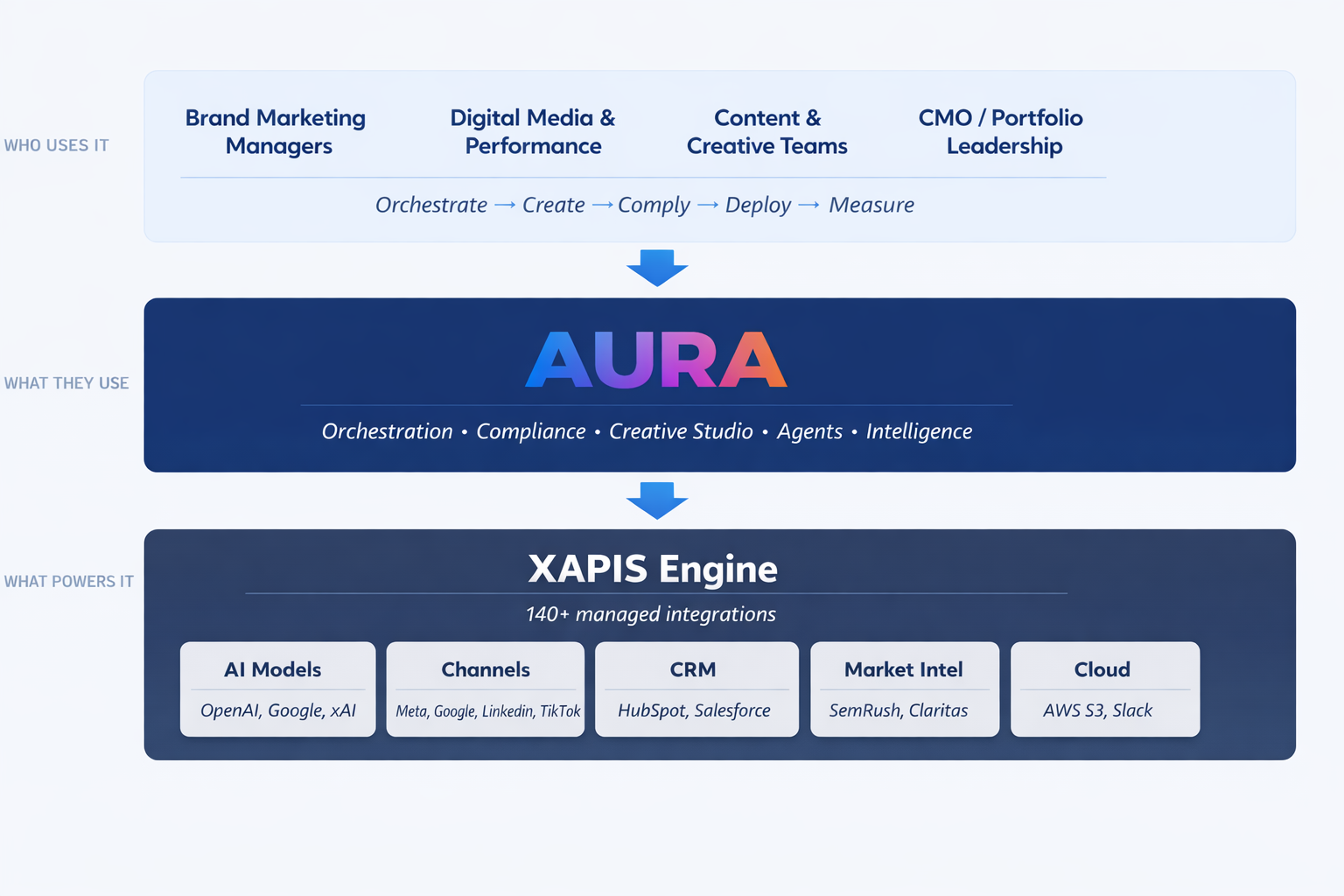
- Global deployment infrastructure. 140+ managed integrations via the XAPIS engine.
- Others manage campaigns. We manage content truth and orchestrate.
IX. Architecture
The diagram reads top-to-bottom: who uses it → what they do in it → what powers it.
X. Strategic Positioning
Four Axes of Independence
AURA is not an agency competitor. It is a client-mandated platform — the orchestration layer the brand owns, above any single agency. That posture operates on four axes:
1. Agency-agnostic. AURA works with any agency — Omnicom, WPP, Publicis, or in-house teams. The brand owns the platform; agencies operate within it at the client's invitation. When a brand changes agencies, the content infrastructure stays.
2. Channel-neutral. Meta wants you to spend more on Meta. Google wants you to spend more on Google. Each platform presents its own performance data to justify its own ROI — and that data is always inflated in their favor. AURA sits above all channels and collates performance data from every one of them into a single, unbiased view. It helps clients make smart decisions about allocating spend across competing channels — something Meta and Google would never offer, because it's not in their interest. Enterprises are flooded with channel data but still struggle to use it for cross-channel allocation decisions. The larger the enterprise, the harder this problem becomes. AURA solves it by having no media inventory to sell and no financial interest in which channel gets the next dollar.
3. Model-agnostic. AURA integrates 10+ AI models (OpenAI, Google, xAI, Stability) and isn't locked to any single provider. Teams pick the best model for each job. No vendor lock-in, no AI platform tax.
4. Open-protocol. AURA speaks MCP (Model Context Protocol) in both directions: it consumes MCPs from Adobe, Salesforce, Veeva, and any other vendor that exposes one, and it publishes its own MCP surface so any AI tool — Claude, Copilot, ChatGPT, agent frameworks — can read AURA's lifecycle data, trigger compliance review, query brand DNA, or push to a channel. Where holdco platforms speak proprietary APIs and point tools speak their own SDKs, AURA speaks the open protocol the rest of the AI ecosystem is converging on. That makes AURA composable into workflows that don't even start inside AURA — and makes its data accessible without an integration project.
To agencies and holdcos: "We don't replace your creative or media. We make it scale globally, faster, without friction — reduced production delays, more effective global creative, fewer vendors, version control, better media ROI."
To clients: "Agencies create, plan, and buy. AURA ensures everything executes flawlessly — correct, compliant, and measurable across every market. And because AURA doesn't sell media, it's the only platform that will tell you the truth about where your money is working."
Why this matters
The large holding-company agencies (WPP, Omnicom, Publicis) fear disintermediation, loss of control, and margin compression. If AURA is positioned as a competing agency product:
- It looks like just another agency AI tool (crowded, commoditized)
- It reduces enterprise trust — perceived as biased toward TransPerfect's own creative services
- Holdcos will view it as a competitive threat and may terminate existing translation and tech partnerships
- It limits new category creation
Instead, positioning AURA as a client-owned GCOS addresses these concerns and opens a category no one else owns.
TransPerfect as Execution Partner
TransPerfect Digital, The Mill, Content Labs, and GlobalLink® are available as execution partners for brands that want TransPerfect's creative, localization, and media capabilities inside the platform. They operate within AURA under the same conditions as any other agency — invited by the client, accountable to the brand's rules. The platform's value doesn't depend on which agencies use it; TransPerfect's teams earn their place on merit, with the advantage of knowing the platform deeply.
XI. Go-to-Market: Beachhead Strategy
Start with compliance and orchestration. Expand into creative and performance.
Phase 1 — Compliance and Orchestration
- Lead with the audit trail and compliance automation — what goes live globally, approved by whom, compliant to what standard.
- Not another agency AI content tool — the execution layer for content lifecycle, localization, compliance, and market deployment.
- Beachhead: compliance automation, localization orchestration, position-based attribution.
- Agencies decide what to say and where to spend — AURA ensures it's correct, compliant, and effective.
Phase 2 — Content Creation
- Expand into AI-powered creative generation within the governed GCOS framework.
- Brand-trained AI agents with built-in compliance guardrails.
Phase 3 — Performance & Optimization
- Full closed-loop: create → comply → deploy → measure → optimize → reallocate.
- Cross-brand comparison for portfolio leadership.
XII. Who It's For
Beachhead Markets
- Life Sciences (Pharma + Biotech) — Existing TransPerfect/GlobalLink® trust, highest compliance requirements, highest cost of error, high content volume. Veeva as source of truth.
- Financial Services — Regulatory compliance, high content volume, global deployment.
- CPG / Travel / Retail — Brand portfolio management, massive content volume, speed-to-market pressure.
Buyer Personas
- Brand holding companies — global portfolios with dozens of brands. AURA gives the parent company a single platform, unified view, and economies of scale. The GCOS becomes the shared platform that all agencies operate within.
- Enterprise brands — in-house marketing teams that want one platform for the full content lifecycle. AURA is the orchestration layer; agencies remain the execution layer.
- CMO / Portfolio leadership — single pane of glass for output, performance, compliance, and AI spend across every brand.
The Agency Relationship
AURA is positioned as a client-mandated ecosystem, not an agency product. The key dynamics:
- Brands own the platform relationship and the data.
- Agencies are invited into the GCOS by their clients — to create, deploy, and optimize within a governed framework.
- AURA makes agencies more efficient (not obsolete) — faster compliance review, automated localization, cross-channel measurement.
- The brand establishes AURA as the shared platform. Agencies operate within it.
Frequently Asked Questions
What is AURA?
AURA gives global brands control of their content lifecycle — what gets created, localized, approved, deployed, and measured, across every market, every agency, and every channel, from a single platform. That's what a Global Content Operating System (GCOS) is. AURA is the first one.
What does GCOS mean?
GCOS stands for Global Content Operating System. It describes a new category of software that orchestrates the full content lifecycle — from creation through performance measurement — across all markets, agencies, and channels. AURA is the first GCOS.
What problems does AURA solve?
Three problems that every global marketing leader recognizes. Control: no one can answer what content is live globally, who approved it, or whether it's compliant — legal review is manual, brand governance drifts, and AI adoption is ungoverned. Speed: production is too slow and too expensive — fragmented tools, agency coordination overhead, and content that gets translated instead of locally adapted. Evidence: no one can prove what's working or where to put the next dollar — every channel reports its own inflated ROI with no unbiased view across the full lifecycle. For brand holding companies, all three problems multiply with every brand added to the portfolio.
How is AURA different from a creative AI tool?
Creative AI tools generate individual assets — images, video, copy. AURA orchestrates the entire content lifecycle: creation, compliance, localization, deployment, and performance measurement. AI-powered creative generation is one capability within AURA, not the whole product. AURA is the orchestration layer; AI tools are engines within it.
How is AURA different from an agency platform like Omnicom's Omni?
The difference is Control of Spend vs. Control of Content. Holdco platforms like Omni control where money goes — they optimize paid reach, frequency, and performance using audience data and identity graphs. AURA controls what gets created, localized, and deployed — it optimizes content production, translation, compliance, and publishing using language infrastructure and regulatory readiness. These are complementary, not competitive. Omni places the right ad in front of the right person; AURA ensures that ad is compliant, on-brand, culturally adapted, and approved for that market. Critically, holdco platforms are captive to their agency network. AURA is agency-agnostic — it works with Omnicom, WPP, Publicis, or any combination, because the brand owns the platform, not the agency.
What happens to our content when we change agencies?
When a brand moves its media or creative account from one agency to another, content built inside the old agency's systems typically has to migrate or be rebuilt. With AURA, the brand owns the content infrastructure — the compliance history, lifecycle audit trail, localized assets, and performance data. Agency transitions don't touch the content layer. The new agency simply operates within the GCOS.
How does AURA work with Adobe Experience Manager (AEM)?
Adobe AEM is the system of record for content at rest — it manages published assets, experiences, and pages. AURA is the system of execution for content in motion — it governs how content is produced, scaled, and optimized across markets before it reaches AEM. AURA sits upstream: it handles AI-driven content creation, in-language authoring, compliance automation, and performance measurement. Adobe handles storage and delivery. Brands running both get a complete stack — AURA produces and governs; Adobe stores and delivers.
Does AURA replace our agencies?
No. AURA is designed to make agencies more effective, not to replace them. Agencies continue to handle creative strategy, media planning, and buying. AURA provides the orchestration layer: compliance automation, localization, version control, and performance measurement. Agencies work faster with less friction inside the GCOS.
Which AI models does AURA use?
AURA integrates 10+ AI models including OpenAI, Google, and xAI for generating images, video, audio, documents, presentations, and code. Each brand can select the best model for each task. All AI usage is governed, auditable, and compliant with brand guidelines.
How does AURA handle compliance and regulatory review?
AURA automates compliance at the point of content creation — not in a downstream review cycle. Brand guidelines, regulatory requirements, and market-specific rules are enforced automatically. Every asset has a full audit trail: who created it, which version, who approved it, where it's live, and when. Manual review cycles that took weeks are reduced to hours.
Which industries is AURA built for?
AURA serves any industry with global content operations, with particular strength in regulated industries: life sciences (pharma and biotech), financial services, and CPG/retail/travel. In regulated industries, AURA's compliance automation is especially valuable because the cost of error is existential — not just reputational.
How does AURA handle localization?
AURA generates content adapted for local audiences from the ground up — built around local search behavior, idiom, and cultural context rather than translated from English. This is powered by TransPerfect's 30+ years of global language infrastructure. Content built this way consistently outperforms direct translation.
What channels does AURA deploy to?
AURA pushes creative campaigns directly into Meta, Google, LinkedIn, TikTok, and Reddit. Content for Amazon, PDPs, and retail partners is exported in channel-ready formats. The manual export-import-review cycle is eliminated.
Why is channel-neutral performance data important?
Every channel — Meta, Google, LinkedIn, TikTok — presents its own performance data to justify its own ROI. That data is always inflated in the channel's favor, because the channel's business model depends on you spending more with them. Every pixel, every measurement vendor, every identity platform reports into its own dashboard with its own attribution model that conveniently credits itself. Advertisers running four platforms get four conflicting answers about what drove the conversion — and no neutral authority to arbitrate.
AURA sits above all of it. It ingests signals from every pixel and every data partner and synthesizes them into a single conflict-free view. AURA has no media inventory to sell, no channel to favor, no financial interest in where the next dollar goes — and that is something no channel, no agency platform, and no DSP can credibly claim. The bigger the enterprise and the more channels it runs, the more valuable this becomes.
How does AURA measure performance?
AURA uses position-based attribution — measuring actual contribution across the full customer journey rather than relying on each platform's self-reported (and inflated) metrics. Performance is tracked across channels, audiences, and geographies in a single view, with automated recommendations for spend reallocation.
What is the XAPIS engine?
XAPIS is the integration engine that powers AURA, providing 140+ managed integrations with CRMs (HubSpot, Salesforce), machine translation systems, market intelligence platforms (SemRush — now Adobe-owned — and Claritas), cloud services, and channel APIs. XAPIS is the infrastructure layer that makes AURA's orchestration possible.
Who at TransPerfect builds AURA?
AURA is built by TransPerfect, drawing on 30+ years of experience in global content, localization, and compliance automation — particularly in high-risk, regulated industries like pharma, financial services, and legal. TransPerfect's enterprise localization infrastructure serves as the foundation for AURA's language and compliance capabilities.
How does AURA work for a brand holding company with multiple brands?
Each brand gets its own AI agent trained on that brand's guidelines, tone, visual standards, and compliance rules. Portfolio leadership gets a single dashboard showing what each brand is producing, spending, and achieving — the single pane of glass that never existed before. The GCOS becomes the shared platform that all agencies across all brands operate within.
Can we start with just one part of AURA?
Yes. AURA is designed for phased adoption. Most enterprises start with compliance and orchestration, then expand into AI-powered creative generation, and finally into channel deployment and performance optimization. Each phase delivers standalone value.