A customer journey map is a visual representation of your customers’ interactions with your brand, product or service.
This important exercise allows you to understand exactly how your customers come into contact with your brand, product or service – and how they become aware of, consider, decide to order from, and advocate your brand.
By defining the stages of the customer journey, you can better understand the customer’s actions, reasoning, and get in depth into the emotions that they experience.
Visualizing the customer experience in detail may unveil common pain points and experience gaps that need to be addressed. These insights will help you to identify how to solve any problems or even seek new opportunities at each stage.
Customer journey mapping can also influence the organization of your company or brand to prioritize a customer-centric experience.
Below is a chart looking at all the steps that marketers go through when setting up some kind of marketing campaign – for example, when launching a new product or expanding into a new market.
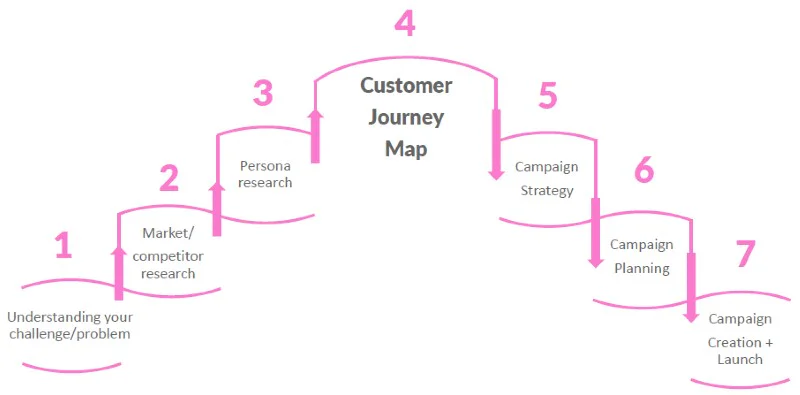
Let’s look at these seven steps in a bit more detail:
The first four steps are like the solid foundation. The other steps can branch out into different directions. Customer journey mapping is something that you can apply to many different areas of digital marketing, whether that is social media, content, paid campaigns, SEO and/or translation; it really is an overarching exercise.
To make this a bit more memorable, we have taken all this and simplified it into this beautiful cake!
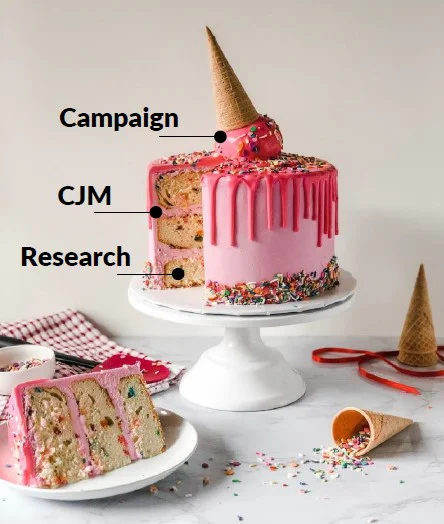
If you want to think about where customer journey mapping fits in the cake: your research is your sponge, it is the base, it is what keeps everything together; your campaign is the beautiful topper and all the decorations that potential customers see on the surface; and the customer journey mapping comes in the middle. It unites your research with your campaign.
Customer journey mapping is the last bit of research that you need to do before creating a strategy. It is also the next logical step after performing persona research, as it helps you to see how your personas behave at each step of their customer journey. Here at TransPerfect Digital, we do not do customer journey mapping without persona research, because they simply go so very well together.
Before we get into the process of how to conduct customer journey mapping, let’s summarize what is actually visualized in the customer journey map itself.
These are the stages that customers experience as they interact with your company or brand. Episodes are diverse, depending on the business and the customer’s journey. In general, however, the episodes are:
This outlines what customers need in order to be at each stage. The needs can be categorized into functional, emotional and social, depending on the business objective. If you map out the needs, you also need to map out the pain points, as they both determine whether the customer continues with or quits the process. This will help you to identify the emotions of the customer at every stage, positive or negative.
By knowing and understanding everything customers do in each stage of the buying process, you also know what touchpoints they encounter. For instance, the customer might be exposed to paid advertising while reading content online, or ask questions to peers through a messaging platform, or use social media for different purposes. This part explores where to reach the customer and how to understand their behavior.
This is the part that summarizes the findings and insights that have already been mapped out. This is where you can analyze the gaps between the customer needs and pain points and solve them by utilizing the touchpoints.
This is the final and perhaps most important part of the customer journey map, where the experience gaps are analyzed. Solutions or opportunities are brainstormed and developed to fill the experience gaps, which will improve the customer experience in that particular stage.
Customer journey mapping is an important part of any brand’s marketing strategy. Here are three top reasons to perform customer journey mapping:
The numbers below demonstrate why customer journey mapping is important in the context of achieving your marketing goals:
Start by defining your business objective. Decide what you are aiming to achieve (e.g. a brand awareness campaign or launching a new product/service). Determining the direction of the customer journey at the start will make the insights more actionable.
You should also define the customer that you want to focus on. The persona’s main needs should already have been stated and researched by this point. This is why prior persona research is vital. Having this clear persona will be helpful for reminding you to tailor every stage of the customer journey map towards them.
If your persona research has dug up multiple personas, you should choose the one that is most relevant to your goal. You could also think about which one is the “core” persona that you most want to target.
Next, you will want to use qualitative and quantitative research methods in order to collect data about your customers’ journeys.
Qualitative research methods:
Quantitative research methods:
List and map out the collected data, fitting it into the appropriate stages to illustrate the journey and the critical moments.
Split the persona’s pain points, desires, touchpoints and core needs into several phases, and evolve the hypothesis map based on the findings of the research.
Based on the visualized customer journey map, analyze the gaps in the customer experience, the information overlap, the significant pain points and the critical stages.
This step allows you to see the range of solutions and opportunities at each stage, as well as to focus on the areas where your customers’ needs are not met, i.e. to identify any areas needing improvement.
You should expect the whole process of producing a customer journey map to take a minimum of one month. Allowing yourself less than one month could be setting yourself up for failure. It may even take longer than one month, depending on how many people you want to interview and the goal you have set up. You should also be aware that if you are interviewing people, this will mean you are dependent on their time, so this again might mean the process takes longer, if they have limited availability.
To aid understanding, here are two examples of successful customer journey mapping, one for a B2B business and one for a B2C business.
Step 1: Set a Goal
The brand is an interior design studio focusing on working spaces, restaurants and retail spaces. It has created a whitepaper about spatial design trends for businesses. Its goal is to get more prospective clients to download the paper.
The target persona is a shop owner based in London who started their business online and is currently expanding to offline stores as well. Their core desire is to have an established brick and mortar shop by the end of the year. If they had to summarize their ultimate aspiration in one sentence, it would be: “My brand will go national and international with its unique design.”
Based on the persona research, you know that the key sources of information (touchpoints) for this persona are:
Step 2: Collect the Data
The following are some good questions to ask this persona in the interview:
Step 3: Visualize the Data
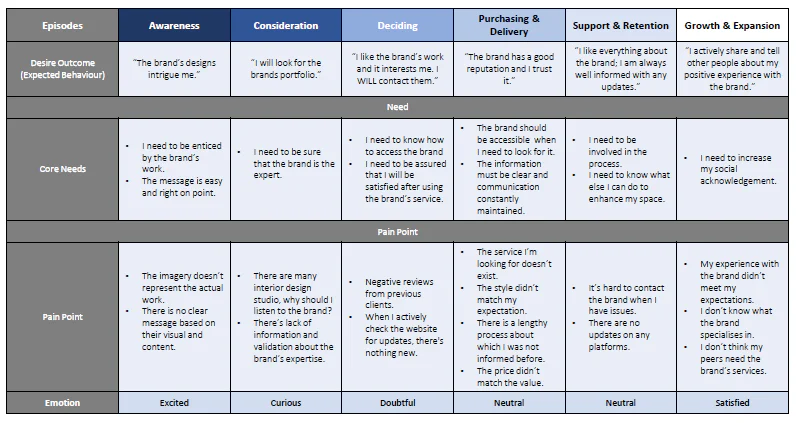
Based on the information gathered in the interviews, you are able to create this customer journey map:
Step 4: Analyze the Data
When you analyze the customer journey map, you realize that the critical stages for this persona are awareness, consideration, and growth and expansion.
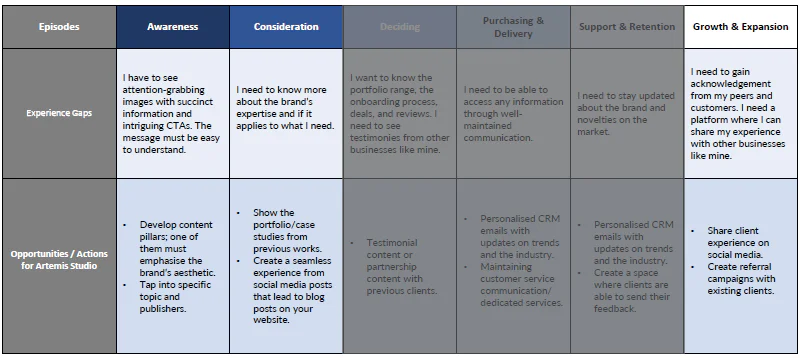
The persona heavily focuses on certain publications and topics. You should use them to create relevant content, as well as in your targeting criteria for your PPC campaigns.
You should tailor your content into several different topics, such as aesthetic, education, and spatial design and its functions. Short video should be used organically or in paid social media campaigns to capture the persona’s attention.
This persona relies on reviews. For them to download the whitepaper, they need information about the brand’s work, including client testimonials. Build a space and incentive for current clients to share their own experiences and advocate your brand.
Step 1: Set a Goal
The brand is a food and beverage company. Its goal is to launch a new product into Asian markets.
The target persona is a woman in her 20s who is very sociable. Persona research has identified this type of person as the ideal customer for this brand.
Step 2: Collect the Data
The following are some good questions to ask this persona in the interview:
Step 3: Visualize the Data
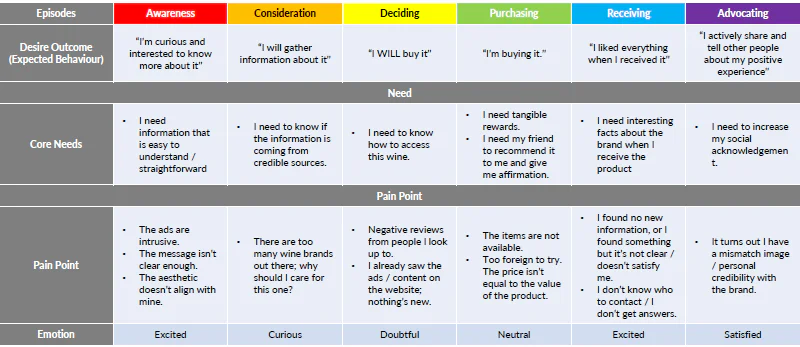
Based on the information gathered in the interviews, you are able to create this customer journey map:
Step 4: Analyze the Data
When you analyze the customer journey map, you realize that the critical stages for this persona are awareness, consideration and receiving.
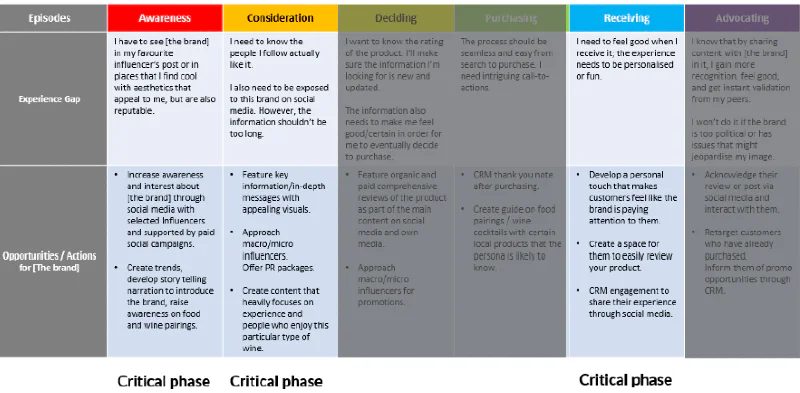
It is important to create excitement for the persona when they discover your brand. You should start by creating content with influencers they follow and an attractive paid social media campaign to support the influencer content.
This persona is very sociable, so you should create content on your social media about different social activities that the persona does with their friends, such as going for picnics, hanging out and creating memories.
Content created for this market has to be inspiring with an aesthetic that is palatable for them. This persona comes from a very artistic background, and therefore art-based visuals are enticing for them.
We hope this guide has provided you with a useful introduction to the topic of customer journey mapping. By doing the research to truly understand your customers’ interactions with your brand, you can create a better, more seamless customer experience for them, addressing their pain points and taking action to provide them with the best possible support at every single stage of the customer journey. This should ultimately lead to happier customers, a better brand reputation, and better business.
Want to discuss how we can help your brand with customer journey mapping? Let’s talk!

TransPerfect Digital
TransPerfect Digital combines best-in-class AI technology with deep human expertise in global marketing, content creation, and localization. As part of the TransPerfect family – operating in a language services market valued at $75.5 billion in 2024 and projected to reach $93.37 billion by 2030 (IMARC Group research) – we bring unmatched capabilities to help global brands connect with customers across languages, cultures, and markets. Our team of 200+ digital marketing specialists works alongside data scientists and AI engineers to deliver solutions that blend technological innovation with strategic insight. We serve more than 1,000 global brands across 170+ languages and 200+ markets.