The goal of localizing a website is to build trust throughout the entire consumer journey, ultimately facilitating transactions. Being perceived as a business that is close to its customers establishes a good base for trust and customer loyalty to develop.
Here at TransPerfect Digital, we are privileged to work with businesses during their expansion into new regions and markets, and we frequently hear the same questions repeated. The key aspects that are most often discussed have been included in this guide, together with a few examples and insights from projects we have worked on. This checklist is particularly designed for digital marketing teams supporting a business’ expansion into a new country.
A customer’s trust is built on many (sometimes very small) signals, so it is essential to have these nailed down.
The “Contact us” page of a website is one of the strongest indicators that a business is well-established in a region and safe to deal with.
Ideally, a local phone number would feature on the website, even if calls are re-directed to an international call center. Be clear about which language is supported by your customer service team; people will naturally assume they can communicate in their local language. If necessary, consider employing native speakers to work in the customer support team.
In highly corporate B2B environments, many professionals are fluent in English, but this also depends on the region. English is likely to be accepted as the language of communication in Sweden, for example, whereas in Italy, local-language communication is generally preferred.
A local postal address is another significant trust signal. People feel more confident to deal with a business when it has an office or a branch located in their country. A local address reassures users that the company is subject to local laws and regulations. Although this is not always the case for international businesses, the perception alone enhances credibility.
The localization of contact forms is often overlooked, and yet getting this wrong may give the impression that the region is not a priority market for the business, as well as making it appear less approachable in case of any questions or issues from customers. In some circumstances, this may even cause potential customers to abandon the website.
Many of us have encountered contact forms designed for US-based companies that require users to select a state from a drop-down menu, which of course is not applicable to other countries. However, without specifying a state, the form may be invalid and unable to be submitted.
Another example is that of Germany, where postcodes consist of five numbers. However, contact forms originally designed for the UK market are to be filled with postcodes made up of letters and numbers, and anything different from that is registered as an error, preventing the user from completing the contact request.
Make sure to localize any units of measurement on your website. For example:
This may not seem like a major issue, as customers could refer to a conversion table on your website, but this would not only be an additional step in the customer journey (which could reduce the conversion rate), but it would also be a clear indicator that the product originates from outside the target market, which could deter some customers.
It is incredible to see the diversity of measurements still actively used around the world. Not paying enough attention to these can prove very detrimental and even cause unnecessary and unexpected additional expenses.
For example, imagine that a user needs to book a 13.5-foot truck to move twelve cable drums. The website says that it has a 4-metre truck available to use immediately, and thinking that sounds about right, the user places the order. It would be a nasty surprise for the user to find out that the difference of 11cm (13.5 feet = 4.11 meters) does not allow all twelve drums to be loaded with the doors locked, and two drums have to be sent separately, at almost the same cost as another ten.
It is essential to offer your customers convenient and familiar payment options. Even if they are only contemplating the possibility of placing an order with your company, this is likely to be a big trust factor – on top of the obvious advantage of enabling the transaction itself to happen. After all, sometimes convenience is valued above the pricing.
PayPal and similar systems are great in supporting quick and smooth purchases. If the product/service can be bought on-the-go, every effort should be made to enable an instant, effortless transaction. Customer intent driven by a short-term impulse, such as a charity video ad at a bus stop, can be fleeting, and the slightest inconvenience is likely to make a visitor abandon the transaction. The same applies in highly competitive markets where similar products are widely available through different suppliers. For example, airport car parking is often listed across comparison booking websites at the same price, so the most convenient option is likely to win the sale.
Remember that credit cards are not the preferred payment method in every country. For example, Germans are used to receiving an invoice with a 30-day payment window after delivery. The more region-specific payment options you are able to offer, the higher the chances of the transaction being completed successfully.
Having the right currency displayed on your website contributes to a positive user experience and should always be a key part of your website localization strategy. If you assume that users will simply check the exchange rate online, you are forgetting that every extra step the customer has to take interrupts the desired visitor path and lowers the conversion rate. Customers may also be concerned about transaction fees if they have to buy in a foreign currency, which might make them leave your website without completing their purchase.
Make sure to localize your delivery and returns policies for every market you are targeting. It is very reassuring for customers to know they can easily resolve any after-sale issues easily.
In one project we worked on, we were tasked with translating website content from British English to German. Our marketing-savvy translators pointed out issues with phrases like “collect from Asda” and “use our Collect+ collection points” in the text which needed translating (Asda and Collect+ do not exist in Germany). We notified the client, who discovered that they had overlooked the entire section in their review, in a rush to meet the deadline to launch the German website.
The acceptable delivery time can also differ considerably across different countries. For example, in the UK, you often see one- or two-day delivery being offered, yet in Italy, the state postal service Poste Italiane typically offers a one- or two-week delivery time. This needs to be taken into account when drafting policies like “please return within 14 days for a full refund”, for example.
Social media can have a big impact on brand reputation and customer trust. Customers can check what kind of communication and feedback is prevailing on a company’s social media account, how quickly and efficiently the company is responding, and how active and consistent the business is on social media.
It is not unusual for customers to get suspicious if they cannot find information on a company anywhere but on their official website. However, to be found in all your target markets, you need to make sure you are on the social networks used by your target audience. For certain countries, this may mean being present on local social networks, such as WeChat in China or KakaoTalk in South Korea.
If you have invested time into creating and maintaining an account on a local social network, remember to link to it from your website. Also consider removing any non-relevant links for the particular market you are in, to make your website look neater and more tailored to the country you wish to enter.
A great way to gain customers’ trust (and perhaps a few backlinks too) is to establish a connection with local authorities and leading professional bodies. Memberships, sponsorships, certifications and award nominations confirm that you are a recognized and respected player in your industry, and a part of the local professional community. Add any badges or official certificates to your website.
We once worked with a business expanding to Italy which was facing notable resistance from the Italian audience, which tends to prefer buying from “Made in Italy” brands, rather than from international companies. After a few challenging months, the breakthrough was made thanks to their participation/sponsorship at a local expo, as well as advertising the Italian version of their website.
If your new target market speaks a different language, high-quality translation is a key investment. This will not be cheap, but the results will be worth it. Invest in good translators and always ensure that the final copy has been checked by a professional human translator whenever machine translation is used. Ideally, your translated content should also be checked by a local team member for business-specific aspects, terms and expressions.
It is important to localize your content even when you are expanding into a market that speaks the “same” language, such as expanding from the UK to the US. This is because there are actually many little differences between the two versions of the language. Taking British English and American English as an example, these two languages have significant differences in their terminology, spelling, grammar and punctuation.
The table below lists just a handful of the hundreds of terminology differences between British English and American English:

And this table illustrates some of the common spelling differences between the two languages:
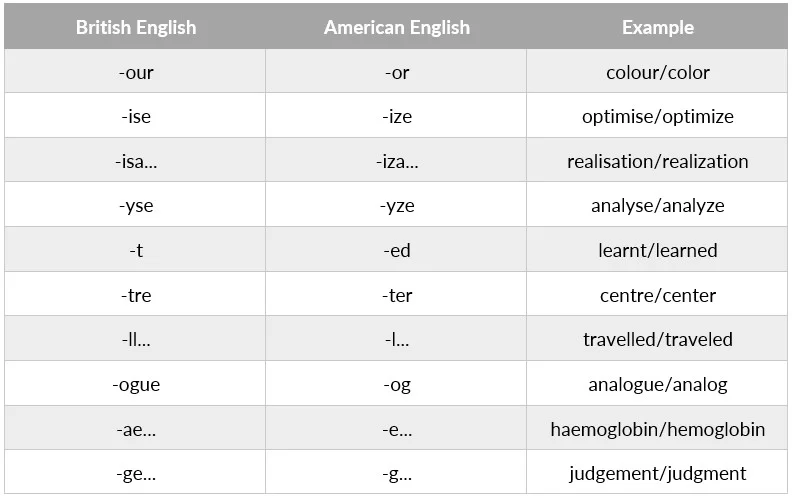
With so many differences between the two varieties of English, you can see how failing to localize the language could lead to customers wrongly assuming that your website is not intended for their market and clicking away. This is why high-quality translation and localization are so vital for success.
To summarize, in order to build trust with your international customers, you need to reassure them that you are committed to serving their market. One of the best ways you can do this is by properly localizing your website, and hopefully with the tips given in this guide, you now have a good idea of what elements are particularly important to focus on.
Want to explore how we can help you localize your website? Let’s talk!

TransPerfect Digital
TransPerfect Digital combines best-in-class AI technology with deep human expertise in global marketing, content creation, and localization. As part of the TransPerfect family – operating in a language services market valued at $75.5 billion in 2024 and projected to reach $93.37 billion by 2030 (IMARC Group research) – we bring unmatched capabilities to help global brands connect with customers across languages, cultures, and markets. Our team of 200+ digital marketing specialists works alongside data scientists and AI engineers to deliver solutions that blend technological innovation with strategic insight. We serve more than 1,000 global brands across 170+ languages and 200+ markets.